
86-025-5119 7362

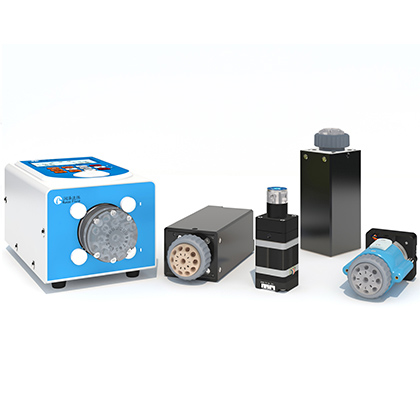
For R&D engineers, procurement managers, and instrument manufacturers evaluating fluid handling architectures for analytical platforms, diagnostic instruments, environmental analyzers, bio-pharmaceutical automation systems, and industrial dispensing lines, the choice between a syringe pump and a peristaltic pump is not a minor component decision — it is a strategic engineering choice that determines the dispensing accuracy, flow stability, pressure capability, maintenance frequency, chemical compatibility, and total cost of ownership of the entire system. Selecting the wrong pump technology for a precision application can create dosing drift that invalidates analytical results, pulsation that destabilizes sensitive detectors, pressure limitations that restrict system design, and maintenance requirements that increase operating cost and reduce instrument uptime.
A precision syringe pump — which controls liquid volume through programmable piston displacement inside a syringe cylinder — is the preferred choice when applications require highly repeatable microliter-to-milliliter liquid transfer, defined-volume dosing, low-pulsation delivery, and stable performance across thousands of aspiration and dispensing cycles in laboratory, industrial, analytical, and automated fluid handling systems. A peristaltic pump — which moves liquid by squeezing flexible tubing — is the preferred choice when applications require simple continuous transfer, tubing-only fluid contact for contamination isolation, and cost-effective flow movement where high-precision volume control is not the primary requirement. Understanding which pump technology fits which application — and why the performance differences between them matter for specific use cases — is the engineering knowledge that allows procurement managers and instrument designers to make the right selection decision the first time. Runze positions its syringe pumps as key fluidic components for transferring liquid with high accuracy requirements, offering industrial syringe pumps, precision mechanical syringe pumps, vertical syringe pumps, continuous syringe pumps, laboratory syringe pumps, programmable syringe pumps, and high-pressure electric syringe pumps.
This guide covers the complete comparison for engineers and procurement teams: why pump selection determines precision fluid handling system performance, what a precision syringe pump is and how it works, how syringe pumps and peristaltic pumps compare across accuracy, pulsation, pressure, and maintenance, why precision syringe pumps are difficult to replace in high-precision analytical instruments, and what selection and maintenance practices support long-term system reliability.
The commercial and technical case for careful pump selection starts with a clear understanding of the specific performance failures that the wrong pump technology creates in precision fluid handling applications — and why each failure has consequences that extend far beyond the pump itself to affect instrument accuracy, validation burden, reagent cost, and customer satisfaction.
Dosing drift from tubing deformation is the accuracy failure that most commonly affects analytical instruments that use peristaltic pumps for precision reagent metering. As peristaltic pump tubing is compressed and released by the rollers through thousands of cycles, the tubing's elastic properties change — the inner diameter deforms, the wall thickness varies, and the volume delivered per revolution drifts from the calibrated value. In an analytical instrument where reagent volume directly affects measurement accuracy, this drift creates systematic error that may not be immediately apparent but progressively degrades result quality until the tubing is replaced and the system is recalibrated. For instruments in regulated environments where calibration records are a compliance requirement, tubing-induced drift creates a validation burden that increases operating cost and reduces instrument availability.
Pulsation interference in sensitive detection systems is the flow stability failure that most directly affects analytical performance in chromatography, spectroscopy, and electrochemical detection systems. A peristaltic pump creates pulsation as each roller compresses and releases the tubing — generating periodic pressure fluctuations in the flow path that can create baseline noise in optical detectors, affect electrochemical signal stability, and introduce timing errors in injection-based analytical systems. A precision syringe pump delivers liquid through controlled piston displacement that produces significantly lower pulsation — making it the preferred choice for analytical flow paths where flow stability directly affects detection sensitivity and result reproducibility.
Pressure limitations that restrict system design is the engineering constraint that most directly affects the range of applications a peristaltic pump can serve. Peristaltic pumps are limited in their pressure capability by the mechanical properties of the tubing — typically to around 0.3 MPa for water — which restricts their use in systems with narrow flow channels, high back-pressure, or pressurized reagent delivery requirements. A high-pressure syringe pump can operate at significantly higher pressures — up to 1.2 MPa for water in Runze's specifications — opening design options that are not available with tubing-based pump technology.
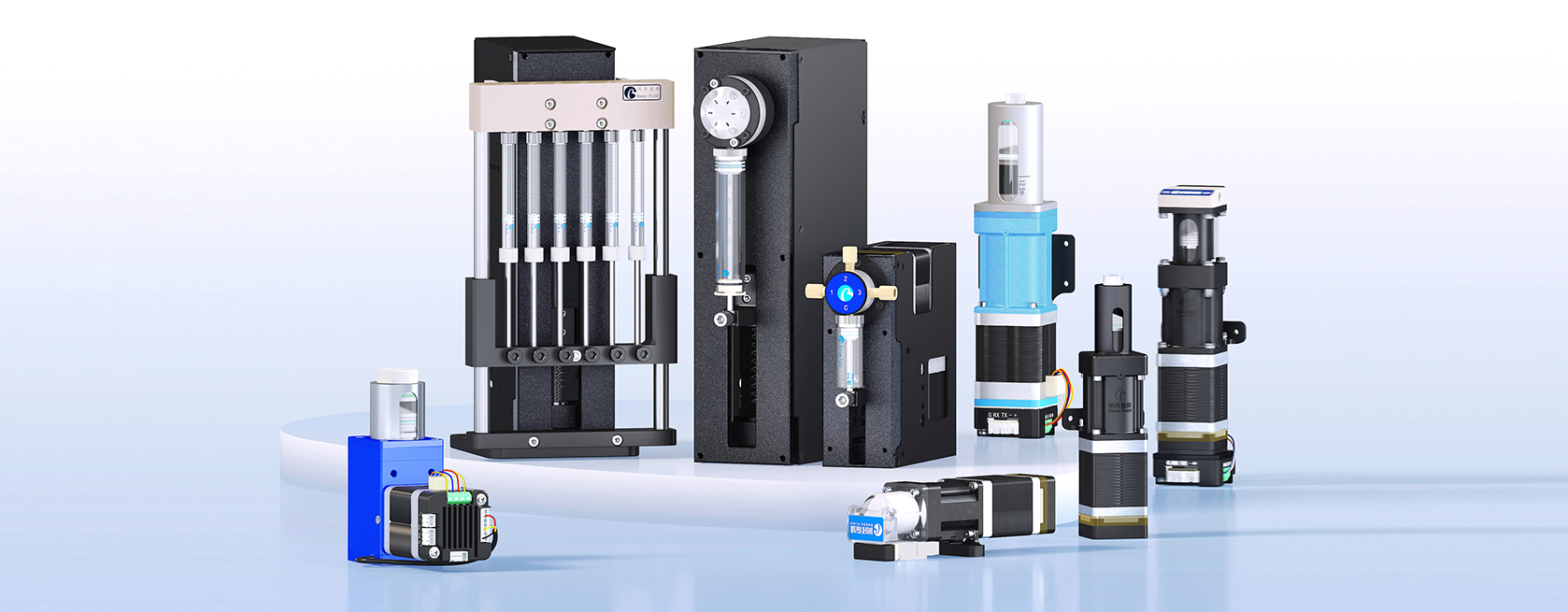
Understanding what a precision syringe pump is — and how its component architecture, motion control, and communication interface work together as a programmable volume-control module — is essential for engineers evaluating syringe pump specifications for instrument integration.
A syringe pump is a precision liquid handling device that uses controlled piston movement inside a syringe cylinder to aspirate and dispense a defined volume of liquid. Runze describes the syringe pump as a fluidic component that transfers liquid with high accuracy, built with components including a stepper motor, stepper driver, lead screw, gearbox, optocouplers, and borosilicate cylinder. The working principle is straightforward: the pump draws medium into the cylinder through piston retraction, a valve controls which channel the medium enters or exits, and the piston advances to dispense the liquid toward the downstream fluid path, dosing needle, valve, tube, or analytical module.
| Component | Function | Engineering Significance |
|---|---|---|
| Stepper motor | Drives controlled motion | Supports repeatable dispensing through precise step control |
| Lead screw | Converts rotary motion to linear piston movement | Affects resolution, stability, and backlash |
| Syringe cylinder | Holds liquid volume | Affects volume accuracy and chemical compatibility |
| Piston and seal | Aspirates and dispenses liquid | Controls leakage and repeatability |
| Valve head | Switches flow channels | Enables aspiration, dispensing, dilution, and distribution |
| Optocoupler sensor | Detects piston position | Supports homing and repeatable control |
| Controller board | Executes commands | Enables programmable automation |
Runze's high precision syringe pump is designed for 0.5 mL to 5 mL applications and supports microliter-to-milliliter fluid handling, with accuracy ≤1% at 100% rated stroke, repeatability of 0.3% to 0.5% at 100% rated stroke, 0.0025 mm per-step resolution, 25 μL to 5 mL syringe options, borosilicate glass, PTFE, sapphire, and PCTFE wetted materials, and RS232, RS485, and CAN communication support — providing the specification depth that precision analytical instrument integration requires.
The systematic comparison of syringe pump and peristaltic pump performance across accuracy, pulsation, pressure capability, maintenance requirements, and chemical compatibility — and the engineering logic that determines which technology is the right choice for specific application requirements — is the core technical knowledge that allows engineers and procurement managers to make the right pump selection decision.
Precision syringe pump accuracy is determined by the precision of the piston displacement mechanism — the lead screw accuracy, stepper motor resolution, and syringe cylinder dimensional consistency — which are mechanical properties that remain stable through the pump's service life as long as the wetted components are properly maintained. Runze lists syringe pump accuracy ≤1% and precision ≤0.7% at full stroke — performance that is consistent and predictable across the pump's operating life.
Peristaltic pump accuracy is determined by the tubing's elastic properties at the moment of measurement — which change as the tubing ages, deforms, and loses its original elastic characteristics through repeated compression cycles. Runze's peristaltic pump FAQ lists approximately ±5% accuracy when tubing is new — a performance level that degrades progressively as the tubing ages and requires recalibration after each tubing replacement.
| Performance Factor | Precision Syringe Pump | Peristaltic Pump | Selection Guidance |
|---|---|---|---|
| Accuracy | ≤1% at full stroke | ±5% when tubing is new | Syringe pump for analytical dosing |
| Repeatability | 0.3% to 0.7% at full stroke | Degrades with tubing wear | Syringe pump for validation-heavy systems |
| Pulsation | Low — controlled piston displacement | Higher — roller compression creates pulses | Syringe pump for sensitive detectors |
| Maximum pressure | 1.2 MPa water | 0.3 MPa water | Syringe pump for high-pressure paths |
| Fluid contact | Syringe barrel, piston, valve, tubing | Tubing only | Peristaltic pump for contamination isolation |
| Maintenance driver | Valve and seal inspection by cycle count | Tubing replacement by runtime | Match to service model |
| Best application | Precision dosing, dilution, injection, metering | Transfer, filling, washing, sampling | Match to process purpose |
For precision fluid handling applications where defined-volume dispensing, low-volume repeatability, stable metering, and lower dependence on consumable deformation are required, a precision syringe pump is the technically superior choice. The piston displacement mechanism provides accuracy and repeatability that are determined by mechanical precision rather than consumable condition — making the syringe pump the appropriate choice for analytical instruments, diagnostic systems, and automated dosing platforms where measurement accuracy is a system performance requirement.
The specific performance characteristics of precision syringe pumps that make them the preferred — and often irreplaceable — choice for high-precision analytical instruments, and how different syringe pump configurations address different analytical application requirements, is the application knowledge that instrument designers need to specify the right pump for their system.
A programmable syringe pump provides the volume control, sequencing capability, and communication interface that automated liquid handling systems require — allowing the pump to execute complex aspiration and dispensing sequences under computer, PLC, Raspberry Pi, or embedded controller command. Runze states that syringe pumps can be programmed using a computer, PLC, Raspberry Pi, or other microcontrollers based on communication protocols, and provides a debugger for trial command testing — supporting the software integration workflow that instrument development requires.
A laboratory syringe pump provides the microliter-to-milliliter volume range, high repeatability, and low dead volume that laboratory analytical instruments require for reagent addition, sample preparation, dilution, and calibration workflows. The 0.0025 mm per-step resolution of Runze's high precision syringe pump supports microliter dispensing accuracy that peristaltic pumps cannot match — making the laboratory syringe pump the appropriate choice for applications where reagent volume directly affects analytical result quality.
An industrial syringe pump provides the cycle-life durability, chemical compatibility, and communication reliability that 24/7 industrial fluid control systems require — operating continuously across millions of aspiration and dispensing cycles without the accuracy degradation that tubing wear creates in peristaltic pump systems. For industrial analytical instruments and process control systems where unplanned downtime creates significant production consequences, the industrial syringe pump's predictable maintenance schedule based on cycle count provides better operational planning than the condition-dependent tubing replacement that peristaltic pumps require.
A high-pressure syringe pump provides the pressure capability that systems with narrow flow channels, high back-pressure, or pressurized reagent delivery requirements need — operating at pressures up to 1.2 MPa for water that are four times the maximum pressure capability of typical peristaltic pumps. For chromatography support systems, pressurized reagent delivery, and analytical instruments with restricted internal flow paths, the high-pressure syringe pump opens design options that tubing-based pump technology cannot support.
For instrument engineers, communication protocol support determines the integration complexity and development time of the pump in the instrument's control architecture. Runze's high precision syringe pump supports RS232 and RS485 baud rates from 9600 to 115200 bps, CAN baud rates from 100 Kbps to 1 Mbps, and up to 15 individual communication addresses — providing the protocol flexibility that covers single-pump bench instruments, multi-pump analytical platforms, and distributed industrial automation architectures. Engineers integrating with Python or LabVIEW should confirm the availability of complete command documentation, address setting methods, and error-code definitions before design-in.
Selecting the right syringe pump for a specific precision fluid handling application requires systematic pre-specification of performance requirements, chemical compatibility needs, communication requirements, and maintenance expectations — and a maintenance program that protects pump accuracy and reliability through the instrument's service life.
Before requesting a quotation for a precision syringe pump, prepare and confirm the following:
Confirm the required dispense volume range — from microliters to milliliters — and verify that the selected syringe volume covers the full range of the application
Confirm the required accuracy and repeatability — and verify that the selected pump specification can consistently meet these requirements across the expected operating temperature range and chemical media
Confirm the liquid media name, viscosity, and chemical compatibility requirements — and request a wetted material compatibility assessment for the syringe cylinder, piston, seal, valve seat, and fittings
Confirm the maximum operating pressure — and verify that the selected pump's pressure rating provides adequate margin above the maximum system back-pressure
Confirm the communication protocol requirement — RS232, RS485, CAN, TTL, or other — and verify that the manufacturer can provide complete command documentation for Python, LabVIEW, PLC, or embedded controller integration
Confirm the valve configuration requirement — the number of ports, valve type, and switching sequence — based on the fluid path architecture of the instrument
Confirm the mounting dimensions and orientation — and verify that the selected pump fits within the available instrument space with adequate clearance for tubing, wiring, and maintenance access
Confirm the expected operating hours per day and annual cycle count — to verify that the selected pump's service life specification is adequate for the application's duty cycle
Flush the fluid path after aggressive, crystallizing, or biological media — residual chemical concentration between operating cycles accelerates seal and valve wear
Avoid particles in the liquid media — particulate contamination is a primary cause of premature seal and valve wear in precision syringe pumps
Verify calibration after long production runs — periodic volume verification confirms that the pump's accuracy has not drifted due to mechanical wear or seal deformation
Monitor leakage, pressure drift, and abnormal motor load as early warning indicators — these parameters change before catastrophic failure and allow preventive maintenance before downtime occurs
Implement preventive maintenance based on cycle count rather than calendar time — a pump in a high-throughput 24/7 instrument accumulates cycles much faster than a pump in a low-volume laboratory application
For peristaltic pump systems: replace tubing based on runtime and chemical exposure, recalibrate flow rate after tubing replacement, and monitor flow drift as tubing ages — because tubing condition is the primary determinant of peristaltic pump accuracy.
In precision fluid handling, the pump selection decision determines system accuracy, flow stability, pressure capability, maintenance frequency, and total cost of ownership — and the engineers and procurement managers who make this decision based on a systematic comparison of performance requirements against pump technology capabilities make the choices that deliver the best long-term outcomes. When the application requires defined-volume dispensing, low-volume repeatability, low pulsation, high pressure capability, and programmable automation integration, a precision syringe pump is the technically superior choice. When the application requires simple continuous transfer, tubing-only fluid contact, and cost-effective flow movement, a peristaltic pump is the more appropriate selection.
Runze provides syringe pumps, high precision syringe pumps, industrial syringe pumps, micro piston pumps, OEM and ODM syringe pumps, peristaltic pumps, multi-position valves, fluidic fittings, tubing, and accessories for environmental analysis, laboratory instruments, medical equipment, petrochemical engineering, food and beverage, and bio-pharmaceutical applications.
Contact Runze today to compare your application requirements — including dispense volume, pressure, accuracy, fluid compatibility, communication protocol, software integration, and budget — and to explore the right syringe pump solution for your industrial, laboratory, programmable, high-pressure, or OEM precision fluid handling application.
Q1: What is the main difference between a syringe pump and a peristaltic pump for precision fluid handling?
A syringe pump uses controlled piston displacement inside a syringe cylinder to aspirate and dispense defined volumes — providing high accuracy, low pulsation, and strong pressure capability. A peristaltic pump moves liquid by squeezing flexible tubing, so the liquid only contacts the tubing — providing simple continuous transfer and contamination isolation but with lower accuracy and pressure capability. The choice depends on whether the application requires precision volume control or simple fluid transfer.
Q2: Which is more accurate: a precision syringe pump or a peristaltic pump?
A precision syringe pump is significantly more accurate for defined-volume dispensing. Runze lists syringe pump accuracy ≤1% and precision ≤0.7% at full stroke, while its peristaltic pump FAQ lists approximately ±5% accuracy when tubing is new — a performance gap that widens as the peristaltic pump tubing ages and deforms through repeated compression cycles.
Q3: Why is a high-pressure syringe pump better for restricted flow paths?
A high-pressure syringe pump can operate at significantly higher pressures than a peristaltic pump — up to 1.2 MPa for water in Runze's specifications, compared with approximately 0.3 MPa for peristaltic pumps. This pressure capability advantage makes the high-pressure syringe pump the appropriate choice for systems with narrow flow channels, high back-pressure, or pressurized reagent delivery requirements that exceed the pressure capability of tubing-based pump technology.
Q4: When should I choose a peristaltic pump instead of a syringe pump?
Choose a peristaltic pump for simple transfer, filling, sampling, washing, filtration, or applications where tubing-only fluid contact is more important than high-precision volume control — such as waste liquid transfer, reagent bottle filling, or washing line flushing where the primary requirement is continuous flow movement rather than defined-volume accuracy.
Q5: Can a programmable syringe pump integrate with Python, LabVIEW, or PLC control systems?
Yes. Runze states that syringe pumps can be programmed using a computer, PLC, Raspberry Pi, or other microcontrollers based on communication protocols. Its high precision syringe pump supports RS232, RS485, and CAN communication with multiple baud rate options and up to 15 individual communication addresses — covering the full range of instrument and automation control architectures. Engineers should confirm the availability of complete command documentation before design-in.
Q6: Why do precision syringe pumps produce less pulsation than peristaltic pumps?
Precision syringe pumps produce less pulsation because they deliver liquid through controlled piston displacement — a smooth, continuous motion that does not create the periodic pressure fluctuations that peristaltic pump rollers generate as they compress and release the tubing. This lower pulsation makes precision syringe pumps the preferred choice for analytical flow paths where flow stability directly affects detection sensitivity and result reproducibility.
Q7: Why choose Runze syringe pumps for precision fluid handling applications?
Runze offers a comprehensive syringe pump range including industrial syringe pumps, precision mechanical syringe pumps, vertical syringe pumps, continuous syringe pumps, laboratory syringe pumps, programmable syringe pumps, and high-pressure electric syringe pumps — with high precision syringe pump specifications including accuracy ≤1%, repeatability 0.3% to 0.5%, RS232, RS485, and CAN communication, multiple syringe volume options, and customizable wetted materials for chemical compatibility across demanding analytical and industrial fluid handling applications.


 English
 日本語
日本語 한국어
한국어 français
 Deutsch
 Español
 italiano
 русский
 português
 Türkçe
 Nederland