
86-025-5119 7362

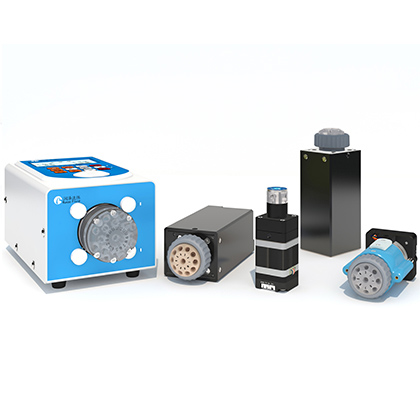
The Rpm-01 reciprocating syringe pump is a compact metering unit for equipment that needs repeated aspiration and discharge rather than a single syringe stroke. The product catalog lists 1 mL, 2 mL, and 3 mL rated capacities, a rated pressure of 0.3 MPa, volume accuracy of plus or minus 1 percent for one full stroke, and repeatability error of 0.3 to 0.7 percent over the rated stroke. Those values define a useful screening envelope, but they do not replace an application test with the selected check valves, tubing, liquid, pressure, and control timing.
The sales application record positions Rpm-01 for compact laboratory and analytical equipment that needs continuous low-volume delivery without peristaltic tubing. That positioning is technically plausible because the unit uses a reciprocating piston and can be paired with one inlet and one outlet check valve. However, continuous delivery still contains a refill phase and depends on valve behavior. System designers must evaluate pulsation, refill time, suction conditions, valve cracking pressure, and any need for a dampener or parallel pump arrangement.
Select Rpm-01 when the required operating point stays within 0.3 MPa, the desired displacement fits a 1 mL, 2 mL, or 3 mL rated capacity, the liquid is compatible with high borosilicate glass and PTFE, and the equipment can accommodate external inlet and outlet check valves. The catalog lists 1 to 180 rpm, RS232, RS485, and CAN communication, DC 24 V at 1.5 A, a 98.6 by 42 by 117.4 mm envelope, and 0.8 kg weight. Do not approve the pump from the rated capacity alone. Verify net delivered flow, refill stability, valve sealing, pressure margin, and repeatability on the complete fluid path.
Rpm-01 uses an eccentric cam transmission to move a piston through repeated intake and discharge strokes. In a continuous-loop arrangement, an inlet check valve opens during aspiration while the outlet side remains closed; the valve states reverse during discharge. The catalog illustrates both a soft-tube connection using a soft-tube check valve and straight connector and a hard-tube connection using a threaded check valve and ferrule fitting. These diagrams show the routing concept, not a universal bill of materials for every pressure, liquid, or tube size.
A single reciprocating chamber does not create perfectly steady flow. During reversal and refill, the instantaneous outlet flow can fall or stop unless the system stores energy or uses another flow source. Compliance in tubing, trapped gas, valve response, and downstream restriction can further change the waveform. If an analyzer requires low pulsation at the detector, measure the time-resolved flow or pressure at the real operating point. Guaranteed pulsation amplitude, check-valve response time, and a validated dampener size are data not available in source documents.
The published values below are screening limits for the Rpm-01 product family. Accuracy and repeatability are stated for a rated stroke, so they should not be applied automatically to partial-stroke dispensing. The three capacity options change the displaced volume per cycle, but the source does not publish a complete flow curve for each capacity across pressure and speed.
Selection item | Published Rpm-01 value | Engineering interpretation |
Rated capacity | 1 mL, 2 mL, or 3 mL | Choose from required displacement and cycle rate, then verify actual delivery |
Volume accuracy | Plus or minus 1 percent for one full stroke | Do not extrapolate to partial strokes without test data |
Repeatability error | 0.3 to 0.7 percent over rated stroke | Confirm with the final liquid, valves, and pressure |
Rated pressure | 0.3 MPa | Include static and transient pressure margin for the full system |
Speed range | 1 to 180 rpm | Net flow also depends on refill and check-valve behavior |
Wetted materials | High borosilicate glass and PTFE | Confirm compatibility with every process and cleaning liquid |
Interfaces | RS232, RS485, and CAN | Confirm protocol, wiring, address, and recovery behavior before integration |
Begin with the required average flow and allowed pressure variation. A first estimate can relate displacement per cycle to cycle rate, but the rated chamber volume is not the same as guaranteed net delivery. Valve dead volume, incomplete filling, dissolved or trapped gas, fluid compressibility, suction restriction, and leakage can reduce output. Use the estimate only to decide whether 1 mL, 2 mL, or 3 mL is a reasonable prototype. Measure the actual mass or volume collected over enough cycles to capture startup and periodic behavior.
Check the inlet side separately from the discharge side. A small chamber operating rapidly can demand a high instantaneous refill rate. Long narrow tubing, viscous liquid, an elevated source, a restrictive inlet valve, or insufficient source head can prevent complete filling even when the average target flow looks modest. The result may appear as low flow, bubbles, unstable delivery, or loss of prime. A slower cycle with a larger chamber may fill more reliably, but that choice can increase pulsation and dose size.
The 0.3 MPa rating must be compared with the worst pressure at the pump, not only the nominal downstream pressure. Include valve cracking pressure, filter loading, narrow fittings, elevation, detector restriction, and blocked-line cases. The source does not publish a pressure-flow derating curve or maximum allowable transient above 0.3 MPa. Keep the design at or below the rated value and establish an equipment-level response to excessive pressure rather than assuming temporary overload is acceptable.
Architecture | Useful characteristic | Main qualification issue |
Rpm-01 with two check valves | Compact repeated aspiration and discharge without peristaltic tubing | Pulsation, valve sealing, refill completeness, and valve compatibility |
Peristaltic pump | Liquid remains inside replaceable tubing and flow direction is easy to reverse | Tube wear, calibration drift, chemical compatibility, and compression setting |
Two coordinated syringe pumps | One pump can discharge while the other refills | Larger control system, switching logic, synchronization, and transition ripple |
This comparison describes architecture, not a universal performance ranking. The correct choice depends on allowable pulsation, wetted materials, maintenance model, required pressure, available space, and control complexity. The source documents do not provide a direct Rpm-01 test against either alternative under identical conditions.
The catalog lists high borosilicate glass and PTFE as wetted materials. Those materials can support many laboratory liquids, but a material name alone does not prove compatibility with a specific concentration, temperature, cleaning agent, or exposure time. The check valves, ferrules, tubing, seals, and connectors add their own materials to the wetted path. Collect a complete liquid list, including rinse and storage liquids, and review every wetted component before prototype testing.
The sales record advises against liquids containing large particles because particles can scratch the glass barrel or PTFE piston and create leakage. That warning is directionally useful, but the source gives no maximum particle size or concentration. Data not available in source documents. If suspended matter is unavoidable, define filtration, inspect surfaces after endurance testing, and monitor leakage or delivery drift rather than relying on a general description such as particle tolerant.
The catalog states a piston-life test result of three million cycles without leakage using pure water, with one rated stroke counted as one cycle. This is a test condition, not a guaranteed service life in process chemicals. Abrasive solids, crystallizing fluids, aggressive cleaning, temperature, pressure, and valve loads can change wear. Use the published result as evidence of the tested configuration and set maintenance intervals from application endurance data.
Rpm-01 is listed for DC 24 V at 1.5 A and offers RS232, RS485, and CAN. Before ordering, confirm the exact protocol implementation, electrical pinout, command set, address behavior, and whether the selected model includes a driver and optional optical sensor. The catalog selection table shows variants with no driver and no optical sensor, no driver with Panasonic optical sensor, or with both driver and optical sensor. The equipment bill of materials should state the required variant explicitly.
The published operating environment is 5 to 55 degrees C and below 80 percent relative humidity without condensation. The 98.6 by 42 by 117.4 mm product envelope and 0.8 kg weight help with placement, but installation must also leave room for tube bends, valve bodies, fittings, wiring, and service access. Mounting orientation, vibration limit, noise, and enclosure ingress rating are data not available in source documents. Confirm these points before freezing a dense instrument layout.
1. Define the target average flow, allowable pulsation, pressure range, and required duty cycle.
2. Choose the 1 mL, 2 mL, or 3 mL chamber as a prototype starting point rather than a guaranteed output.
3. Specify the inlet and outlet check valves, cracking pressure, orientation, tubing, and connector materials.
4. Test priming and refill at the worst suction condition, viscosity, temperature, and source level.
5. Measure full-stroke delivery, repeatability, pressure ripple, bubbles, and valve leakage over enough cycles.
6. Confirm communication recovery, power interruption behavior, fault handling, and the exact ordered driver variant.
7. Run an endurance test with the production liquid and cleaning process before setting maintenance intervals.
The catalog lists rated capacities of 1 mL, 2 mL, and 3 mL. Select a prototype from the required displacement and cycle rate, then measure net delivery because check valves and incomplete filling can reduce actual output.
It can repeat aspiration and discharge through external inlet and outlet check valves. A single chamber still has reversal and refill phases, so steady outlet flow and pulsation must be verified for the application.
The rated pressure is 0.3 MPa. The design review should include valve cracking pressure, filters, fittings, elevation, transient pressure, and blocked-line behavior rather than comparing only the normal downstream pressure.
The catalog states volume accuracy of plus or minus 1 percent for one full stroke and repeatability error of 0.3 to 0.7 percent over the rated stroke. Partial-stroke performance is data not available in source documents.
The pump lists high borosilicate glass and PTFE. The complete fluid path also includes check valves, fittings, tubing, and seals, so compatibility must be reviewed for every process and cleaning liquid.
The catalog lists RS232, RS485, and CAN. Confirm the exact protocol, pinout, addresses, driver configuration, and recovery sequence for the ordered variant.
No. The catalog describes three million cycles without leakage in a pure-water test with one rated stroke per cycle. Process chemicals, particles, pressure, and cleaning can change wear, so application endurance testing is required.
The Rpm-01 reciprocating syringe pump is a practical candidate for compact continuous metering when the process fits its 1 mL to 3 mL capacity options, 0.3 MPa rated pressure, glass and PTFE wetted path, and external check-valve architecture. A defensible selection depends on more than the catalog displacement: verify refill completeness, pulsation, pressure margin, valve sealing, compatibility, communication, and endurance on the assembled system. Use the published full-stroke accuracy and pure-water life test as bounded evidence, not as guarantees for untested liquids or partial strokes.



 English
 日本語
 한국어
 français
 Deutsch
 Español
 italiano
 русский
 português
 Türkçe
 Nederland