
86-025-5119 7362

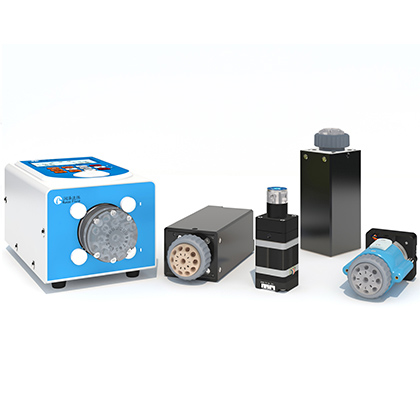
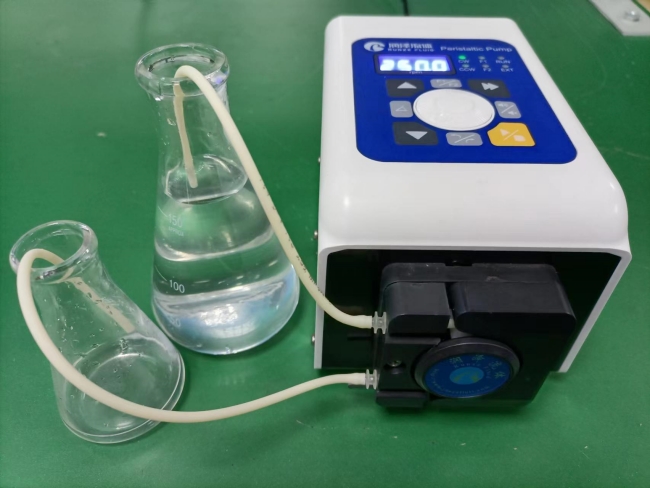
In practical applications, customers often need to select the appropriate tubing inner diameter for a peristaltic pump based on the required flow rate, or determine the speed needed to achieve a specific flow rate when the tubing and pump head model are known. However, the lack of clear data on the relationship between flow rate and tubing inner diameter makes the selection process difficult. This article provides a clear selection method using experimentally derived formulas.
2.1 Relationship between Flow Rate, Tubing Inner Diameter, and Rotational Speed
Through multiple experiments, it was found that the flow rate Q of a peristaltic pump is proportional to the square of the tubing inner radius r2 and the rotational speed
N, as follows:
Where:
Q —— Flow rate, in mL/s
r —— Tubing inner radius, in cm
N —— Rotational speed, in rpm
k —— Empirical constant, dependent on the pump head type, valid within the pump’s head range.
2.2 Constant k Values for Different Pump Head Types
Pump Head Type | Constant k |
SN-3 rotor | 0.586 |
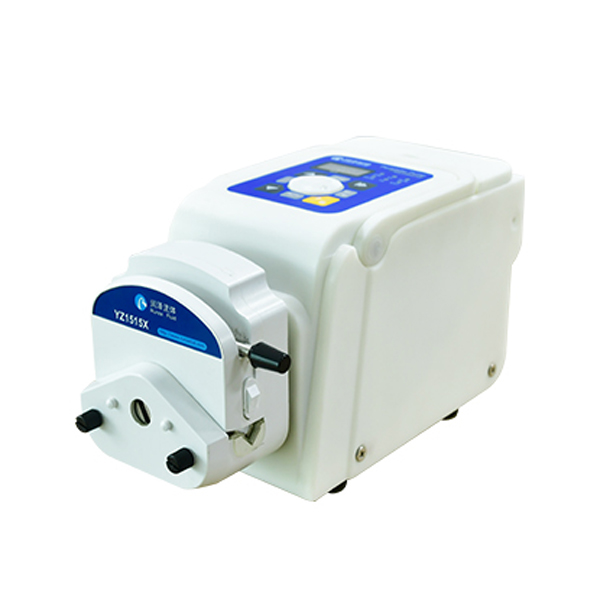
YZ1515-3 rotor | 0.592 |
YZ1515-6 rotor | 0.434 |
YZ2515-3 rotor | 0.536 |
RZ1030(B)-4 rotor | 0.385 |
RZ01-4 rotor | 0.327 |
RZ02-3 rotor | 0.427 |
RZ02-6 rotor | 0.309 |
Determining Required Rotational Speed Given Pump Head and Tubing Inner Diameter
From the basic formula:
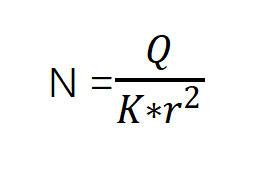
Example: Customer uses RZ1030B-4 rotor pump head with tubing inner diameter 0.142 cm (0142-008 tubing), required flow rate 35 mL/min = 0.5833 mL/s. Find speed.
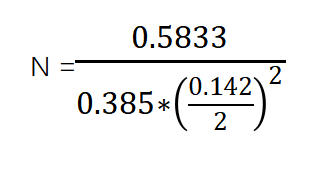
Inner diameter 0.142 cm → radius 0.071 cm, radius squared = 0.005041 cm²
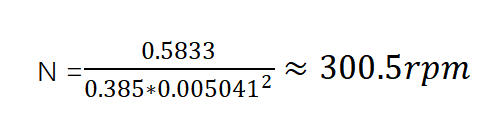
Recommended speed: 300 rpm. Measured results agree with the calculation.
Determining Suitable Tubing Inner Diameter Given Flow Rate and Rotational Speed
From the formula:
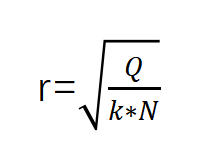
Example: Customer uses YZ1515-3 rotor pump head at 400 rpm, required flow rate 360 mL/min = 6 mL/s. Find suitable tubing inner diameter.
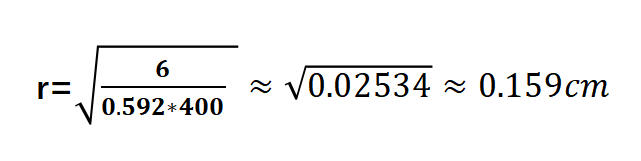
Diameter d=2r≈0.318cm=3.18mm
Recommend 16# tubing with inner diameter 3.2 mm. Measured results agree with the calculation.
When the pump head type and tubing model are known, the required rotational speed for a target flow rate can be calculated using N=Q/(kr2)
When the customer provides a flow rate requirement, the appropriate tubing inner diameter can be determined using 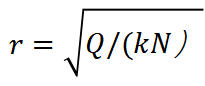 , given the pump head type and rotational speed.
The constant k values listed in this article apply to common pump head types. For complex working conditions (e.g., high-viscosity liquids, long-distance delivery), simulated testing or technical support is recommended.



 English
 日本語
日本語 한국어
한국어 français
 Deutsch
 Español
 italiano
 русский
 português
 Türkçe
 Nederland