
86-025-5119 7362

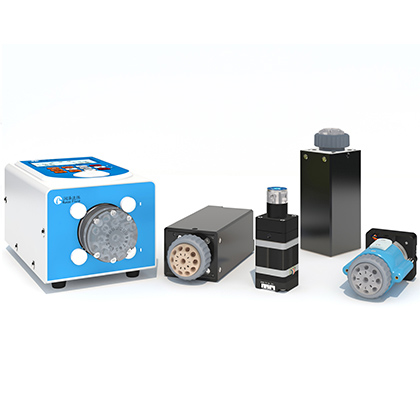
An 8-channel syringe pump can reduce the number of separate fluid-handling modules in an OEM instrument, but channel count alone does not determine whether it is the right architecture. Engineers also need to compare fluid routing, control interfaces, service access, pressure, syringe capacity, wetted materials, and the degree of simultaneous operation required. The RUNZE SY-03B T-DK documentation provides a defined eight-channel configuration and the technical boundaries needed for an initial evaluation. It does not, however, provide customer-specific total cost, synchronization tolerance, or application accuracy. Those items must remain part of the integrator's own design verification rather than being assumed from a product label.
Quick answer: Choose an integrated eight-channel design when the application truly needs several syringe-and-valve channels in one module and the documented pressure, syringe, interface, size, power, and environmental limits fit the instrument. Choose separate pumps when channel-level physical independence, distributed placement, or isolated service is more important. A pump plus selector valve is a different architecture: it can route one pumping source among paths, but it should not be treated as equivalent to eight independently actuated syringe channels without a verified sequence and timing analysis.
The product catalog lists the SY-03B T-DK as a high-precision parallel micro syringe pump with configurations from one to eight channels. The eight-channel version uses independent three-way solenoid-valve assemblies and a 60 mm rated stroke. The ASCII-protocol parameter table lists 6,000 control steps, or 48,000 steps in microstep mode, a control resolution of 0.01 mm per step, a maximum motor speed of 900 rpm, and a linear-speed range of 0.01 to 60 mm/s. These are motion and product-configuration specifications; they are not a guarantee that every liquid, outlet geometry, or dispense volume will achieve the rated-stroke accuracy figures.
The same table lists liquid-volume accuracy of <=1% at rated stroke and repeatability error of 0.3%-0.5% at rated stroke. Supported optional TK60 syringe capacities are 50 uL, 100 uL, 250 uL, 500 uL, 1 mL, 2.5 mL, and 5 mL. The documented maximum reference pressure for the fluid path is 0.15 MPa. Wetted materials are listed as borosilicate glass, PTFE, FKM, PPS, and PEEK. Fluid and syringe ports use 1/4-28 UNF internal threads.
For integration, the catalog lists RS232/RS485 at 9,600 or 38,400 bps, CAN at 100, 200, or 500 kbps or 1 Mbps, up to 15 individual addresses, and a DC 24 V/3 A supply. The specified operating environment is 5-55 C and below 80% RH without condensation. Overall dimensions are 196 x 157.5 x 254 mm and weight is 3.8 kg. These values give an OEM team a concrete envelope for the first mechanical, electrical, and software feasibility review.
The three architectures solve different control problems. The table distinguishes documented facts from design implications and missing data. Where the supplied sources do not quantify an item, the entry states that limitation instead of filling it with an estimate.
Criterion | Integrated 8-channel SY-03B T-DK | Eight separate single pumps | One pump plus selector valve |
Pumping channels | Catalog configuration with eight syringe/valve channels | Eight independently selected pump modules | One pumping source routed among paths; exact sequence depends on the valve and control design |
Specified envelope | 196 x 157.5 x 254 mm; 3.8 kg | Data not available in source documents. | Data not available in source documents. |
Channel service | Valve heads are documented as independently replaceable | Service approach depends on the selected pump model | Service approach depends on pump, valve, and manifold design |
Communications | RS232/RS485 and CAN rates documented; up to 15 addresses | Depends on the selected single-pump model and network plan | Depends on both pump and valve controllers |
Simultaneous operation | Catalog describes parallel micro syringe-pump architecture and same-draw/same-dispense use | Potentially independent, subject to controller design | Generally sequential routing unless the complete system provides another mechanism |
Pressure limit | 0.15 MPa maximum fluid-path reference value | Data not available in source documents. | Data not available in source documents. |
Acquisition and lifecycle cost | Data not available in source documents. | Data not available in source documents. | Data not available in source documents. |
An 8-channel syringe pump is a strong candidate when the instrument needs several metering channels located together, uses compatible syringe capacities, and can operate within the documented 0.15 MPa fluid-path reference limit. The architecture is also relevant when a shared mechanical envelope and common communications family simplify integration. The catalog specifically describes multi-valve integration in one product and notes that, in defined same-draw and same-dispense applications, one unit can replace multiple units. That statement should be applied only after the actual sequence has been mapped; it does not mean the product replaces eight pumps in every process.
Separate single pumps can still be the better engineering choice if channels must be distributed around the instrument, if one channel must be removed without disturbing a central module, or if channels need different pressure, syringe, or material specifications. Those benefits are architectural reasoning, not measured comparisons from the supplied sources. Pump-plus-selector designs may use fewer pumping elements, but a selector routes flow rather than creating additional simultaneous pumping axes. If the assay requires overlapping aspiration, dispensing, or independent channel timing, a timing diagram is essential before treating architectures as interchangeable.
1. Define the liquid task before the channel count. Record how many fluids, destinations, and simultaneous actions exist in one cycle. Separate true parallel metering from sequential routing. A stated need for eight ports is not automatically a need for eight pumping channels.
2. Check the hydraulic boundary. Compare normal and worst-case fluid-path pressure with the documented 0.15 MPa maximum reference value. Include tubing, needles, fittings, filters, elevation, viscosity, and transient restrictions in the system review. Pressure margin for the final application is not specified in the supplied sources.
3. Match the metered volume to a documented syringe option. The T-DK list covers 50 uL through 5 mL TK60 syringes. Select the syringe only after defining the useful stroke range and required dispense volume. The catalog's <=1% accuracy and 0.3%-0.5% repeatability apply at rated stroke, not automatically to every small fractional stroke.
4. Review chemical compatibility as a complete wetted path. The listed materials are borosilicate glass, PTFE, FKM, PPS, and PEEK. Compatibility data for the customer's exact liquid, concentration, temperature, exposure time, and cleaning method are not included in the source documents, so they require a separate materials review.
5. Reserve mechanical, electrical, and communication resources. Use the documented 196 x 157.5 x 254 mm envelope, 3.8 kg weight, DC 24 V/3 A supply, mounting drawing, interface rates, and address limit during the first layout. Then verify connector access, cable bend space, syringe replacement clearance, and valve-head service clearance in CAD.
6. Create an application validation plan. Test the real liquid, tubing, fittings, outlet, temperature, pressure, dispense volume, and control sequence. Define acceptance limits for channel-to-channel variation, carryover, bubble management, cycle time, recovery after interruption, and service replacement. Data for these system-level metrics are not available in the source documents.
A RUNZE laboratory report for a different product configuration, the SY-03B DK-60-T6 with a 500 uL syringe, illustrates why application testing matters. In that one-unit water test, ten 4 uL dispenses at V6000 produced an average gravimetric result of 0.00402 g, a reported repeatability error of 5.84%, and a maximum deviation of 0.0006 g. The report used a 1 m FEP outlet line, a small needle, 20 +/- 2 C, and prefilled tubing. This is not an eight-channel T-DK performance claim and must not be generalized to another configuration. It simply shows that a very small dispense can behave differently from a rated-stroke specification and that the complete fluid path and measurement method belong in the validation plan.
How many channels must meter liquid at the same time, and how many only need sequential access?
What are the normal and worst-case pressures, including restrictions and transient events?
Which liquid, concentration, cleaning agent, temperature, and exposure time contact each wetted material?
What dispense range and acceptance method will be used, especially below a small fraction of rated stroke?
Which interface, baud rate, CAN rate, addressing plan, and fault-recovery behavior will the host implement?
What service procedure is acceptable if a syringe or independently replaceable valve head needs attention?
1. Does an eight-channel module always replace eight single pumps?
No. The catalog states that the integrated product can replace multiple units in specific same-draw and same-dispense applications. Whether it replaces eight separate pumps depends on the actual timing, independence, pressure, volume, and service requirements. A cycle diagram should be reviewed before making that equivalence.
2. What syringe sizes are documented for the SY-03B T-DK?
The catalog lists optional TK60 syringes of 50 uL, 100 uL, 250 uL, 500 uL, 1 mL, 2.5 mL, and 5 mL. It does not provide application accuracy for every syringe and dispense combination, so the selected combination must be tested at the intended working volume.
3. What is the documented pressure limit?
The fluid-path maximum pressure is listed as a 0.15 MPa reference value. The source does not provide a recommended design margin or performance curve across liquids and restrictions. The complete system should therefore be evaluated at normal and worst-case pressure.
4. Which communication interfaces are available?
The catalog lists RS232/RS485 at 9,600 and 38,400 bps, plus CAN at 100, 200, and 500 kbps and 1 Mbps. It also lists up to 15 individual addresses. The host's command set, error handling, and bus topology should be verified against the current protocol manual before software release.
5. Are all eight channels proven to have identical accuracy?
Data not available in source documents. The catalog provides rated-stroke accuracy and repeatability figures for the product, but the supplied sources do not contain an eight-channel channel-to-channel study. The OEM validation plan should define and measure that requirement if it matters to the assay.
6. Is the integrated module always less expensive?
Data not available in source documents. The sales experience recommends comparing total installed and lifecycle cost rather than purchase price alone, but it contains no verified cost model. Compare pumps, valves, tubing, wiring, controller resources, assembly time, validation, spares, and service labor using project-specific quotations and internal labor assumptions.
An 8-channel syringe pump should be selected because its documented architecture fits the process, not simply because eight channels sound more integrated. For the SY-03B T-DK, engineers can begin with verified limits for syringe options, rated stroke, motion control, pressure, wetted materials, interfaces, power, environment, size, and weight. They should then compare those limits with the real sequence and test the complete fluid path at the required volumes. Where cost, synchronization, channel-to-channel accuracy, or lifecycle data are absent, keep them as open validation items rather than assumptions.


 English
 日本語
日本語 한국어
한국어 français
 Deutsch
 Español
 italiano
 русский
 português
 Türkçe
 Nederland