
86-025-5119 7362

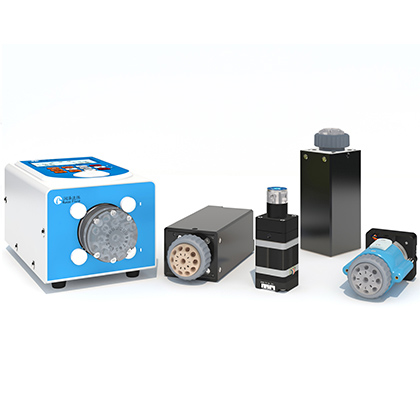
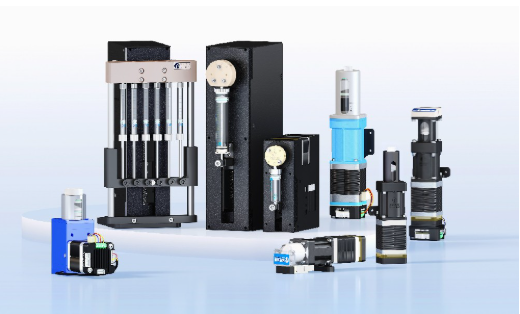
Syringe pump flow rate calculation is required when an engineer needs to convert a target liquid delivery rate into a control parameter for an instrument, controller, PLC, or host computer. In the Runze Fluid source documents, this calculation is described for two control approaches: ASCII protocol pulse rate and Runze custom protocol motor speed. Both methods use syringe volume and total stroke steps as the base variables, but they use different control outputs and different flow-rate units.
The source case was prepared for syringe pump products and tested with an SY-03B syringe pump. The documented test environment included drive software version V4.21, a 24 V power adapter, Serialcomm V1.3.0, a computer as the host controller, and serial communication interfaces including RS485, RS232, and CAN. The same source also uses SY-08 5 mL syringe pump examples to show how to convert between pulse rate, motor speed, and flow rate.
This article explains the documented formulas, unit conversions, and calculation examples. It is written for OEM engineers, laboratory instrument designers, fluid control engineers, and service teams who need to set or verify syringe pump control parameters. It does not add unsupported performance specifications. If a value is not available in the source documents, the article states: Data not available in source documents.
For ASCII protocol syringe pump control, calculate pulse rate with V = b x c / a, where V is pulse rate in Hz, a is syringe volume in uL, b is total stroke steps, and c is required flow rate in uL/s. For Runze custom protocol control, calculate motor speed with R = b x c / (a x d), where R is motor speed in rpm, c is required flow rate in uL/min, and d is motor steps per revolution.
In the source example, an SY-08 5 mL syringe pump with a = 5000 uL, b = 24000 steps, and c = 100 uL/s requires V = 480 Hz under ASCII protocol. In the Runze protocol example, an SY-08 5 mL syringe pump with a = 5000 uL, b = 12000 steps, c = 16680 uL/min, and d = 200 steps/rev requires R = 200 rpm.
The following table summarizes the source data used in this article. These values are taken from the uploaded Runze Fluid wiki source document for product flow-rate calculation. They should be treated as documented examples, not universal specifications for every syringe pump configuration.
Source item | Documented value |
Sample product in source case | SY-03B syringe pump |
Example product used in calculations | SY-08 5 mL syringe pump |
Drive software version | V4.21 |
Power supply | 24 V power adapter |
Debugging tool | Serialcomm V1.3.0 |
Host control method | Computer, MCU, or PLC |
Communication interfaces listed | RS485, RS232, CAN |
Test location | Runze Fluid technical support / comprehensive performance laboratory |
The source document states that calculation files can be provided so users can enter values and convert between flow rate, pulse rate, and motor speed. The article below reproduces the documented formulas and examples in written form so the calculation logic is clear before it is applied in a controller or instrument software.
Item | ASCII protocol calculation | Runze custom protocol calculation |
Control parameter | V | R |
Parameter meaning | Pulse rate | Motor speed |
Parameter unit | Hz | rpm |
Flow-rate unit in source formula | uL/s | uL/min |
Main formula | V = b x c / a | R = b x c / (a x d) |
Reverse formula | c = a x V / b | c = a x d x R / b |
Additional variable | None in source formula | d = motor steps per revolution |
Best use in article context | When controlling by pulse rate | When controlling by motor speed |
The most important practical difference is unit handling. The ASCII formula in the source document uses uL/s, while the Runze protocol motor-speed formula uses uL/min. Mixing these units will produce incorrect control parameters. Engineers should check the protocol first, then convert the flow rate into the unit required by that formula.
In ASCII protocol control, the source document defines V as the pulse rate in Hz. The formula converts a required syringe pump flow rate into the pulse rate command parameter. The documented symbols are shown below.
Symbol | Meaning | Unit |
a | Syringe volume | uL |
b | Total stroke steps | steps |
c | Required flow rate | uL/s |
V | Pulse rate | Hz |
V = b x c / a
c = a x V / b
The formula is useful when the target flow rate is known and the engineer needs to calculate the pulse rate to send to the pump. The reverse formula is useful during troubleshooting or verification, when a V value is already configured and the engineer needs to estimate the resulting flow rate from the documented stroke data.
The source example uses an SY-08 5 mL syringe pump. The documented values are syringe volume a = 5000 uL, total stroke steps b = 24000 steps, and required flow rate c = 100 uL/s.
Step | Calculation |
Input | a = 5000 uL; b = 24000 steps; c = 100 uL/s |
Formula | V = b x c / a |
Substitution | V = 24000 x 100 / 5000 |
Result | V = 480 Hz |
For this example, the required ASCII pulse rate is 480 Hz. This value is a parameter conversion result from the source formula. Actual delivered liquid volume should still be checked under the final system conditions.
The source document also provides the reverse calculation. For an SY-08 5 mL syringe pump with a = 5000 uL, b = 24000 steps, and V = 500 Hz, the flow rate is calculated as follows.
Step | Calculation |
Input | a = 5000 uL; b = 24000 steps; V = 500 Hz |
Formula | c = a x V / b |
Substitution | c = 5000 x 500 / 24000 |
Result | c = 104 uL/s |
This reverse calculation helps service engineers compare the configured pulse rate with the expected flow-rate output. If the measured output differs, the cause may be outside the formula itself, such as air in the syringe, tubing compliance, fluid resistance, valve timing, or incorrect syringe configuration. Quantified correction factors for these causes are not available in the source documents.
For Runze custom protocol control, the source document calculates motor speed R in revolutions per minute. This method uses syringe volume, total stroke steps, required flow rate, and motor steps per revolution. The documented symbols are shown below.
Symbol | Meaning | Unit |
a | Syringe volume | uL |
b | Total stroke steps | steps |
c | Required flow rate | uL/min |
R | Motor speed | rpm |
d | Motor steps per revolution | steps/rev |
R = b x c / (a x d)
c = a x d x R / b
This formula is useful when the instrument software needs to set a motor speed rather than a pulse-rate value. The source example also shows how d can be calculated from motor step angle. For a 1.8 degree step angle motor, d = 360 / 1.8 = 200 steps per revolution.
The source example uses an SY-08 5 mL syringe pump. The documented values are a = 5000 uL, b = 12000 steps, c = 16680 uL/min, and d = 200 steps/rev.
Step | Calculation |
Input | a = 5000 uL; b = 12000 steps; c = 16680 uL/min; d = 200 steps/rev |
Formula | R = b x c / (a x d) |
Substitution | R = 12000 x 16680 / 5000 / 200 |
Result | R = 200 rpm |
The calculated motor speed is 200 rpm. The source document presents this as a parameter calculation example. It does not provide a universal maximum operating speed, minimum stable speed, or flow accuracy specification for all syringe pump models.
The source document also provides the reverse calculation. With a = 5000 uL, b = 12000 steps, d = 200 steps/rev, and R = 200 rpm, the flow rate is calculated as follows.
Step | Calculation |
Input | a = 5000 uL; b = 12000 steps; d = 200 steps/rev; R = 200 rpm |
Formula | c = a x d x R / b |
Substitution | c = 5000 x 200 x 200 / 12000 |
Result | c = 16666.6 uL/min = 277.78 uL/s |
The slight difference between 16680 uL/min in the forward example and 16666.6 uL/min in the reverse example reflects the values documented in the source text. The article preserves these values rather than normalizing them into an unsupported specification.
The formulas above convert between control parameters and theoretical flow rate based on syringe volume and stroke steps. They are useful during integration, but they do not replace verification with the actual liquid path. A syringe pump in an instrument is affected by the complete fluidic system, not only the pump command.
- Confirm the syringe volume used in the calculation.
- Confirm the total stroke steps for the selected pump and syringe configuration.
- Confirm the communication protocol before choosing the formula.
- Use uL/s for the ASCII pulse-rate formula and uL/min for the Runze protocol speed formula.
- Check that the motor step angle and steps per revolution match the source assumptions before using d = 200.
- Verify liquid output under the actual tubing, valve, fluid, and back-pressure conditions.
- Record the configured parameter and measured output so the instrument software and service procedure use the same reference.
The source documents do not provide quantified correction factors for viscosity, tubing length, valve dead volume, fluid compressibility, trapped air, or back pressure. Data not available in source documents.
The most common engineering error is using the correct formula with the wrong unit. For ASCII protocol, the source formula uses c in uL/s. For Runze custom protocol, the source formula uses c in uL/min. A value entered in the wrong unit can create a control parameter that is off by a factor of 60.
Another error is using the stroke-step value from one pump or syringe configuration on another configuration. The examples use b = 24000 steps in the ASCII calculation and b = 12000 steps in the Runze protocol calculation. These are source examples, not a general rule for every syringe pump. The engineer should use the value documented for the selected pump, syringe, firmware, and protocol.
A third error is treating the calculated value as a final dispensing accuracy guarantee. The formula gives the command-side conversion. It does not quantify mechanical tolerance, liquid compressibility, or system pressure effects. Final performance should be measured in the application environment.
The primary keyword is syringe pump flow rate calculation. It appears in the title, first paragraph, an H2 section, and the conclusion.
In the source document, V is the pulse rate in Hz. It is calculated as V = b x c / a, where a is syringe volume, b is total stroke steps, and c is required flow rate in uL/s.
R is motor speed in rpm. The source formula is R = b x c / (a x d), where d is motor steps per revolution.
The source document presents the ASCII example with flow rate in uL/s and the Runze protocol speed calculation with flow rate in uL/min. Engineers should keep these units consistent when applying the formulas.
No. They convert control parameters from documented syringe volume and step values. Final accuracy should be verified under actual liquid path conditions. Data not available in source documents for a universal accuracy guarantee.
The source case lists RS485, RS232, and CAN as serial communication options.
The source documents do not provide a universal correction factor for viscosity, tubing length, back pressure, valve timing, or fluid compressibility. Data not available in source documents.
Syringe pump flow rate calculation depends on knowing syringe volume, total stroke steps, required flow rate, and control protocol. For ASCII protocol, the documented conversion is V = b x c / a. For Runze custom protocol, the documented conversion is R = b x c / (a x d). These formulas help OEM engineers convert application flow requirements into pump control parameters, but final configuration should be validated with the actual syringe, tubing, valve, fluid, and controller used in the instrument.



 English
 日本語
日本語 한국어
한국어 français
 Deutsch
 Español
 italiano
 русский
 português
 Türkçe
 Nederland