
86-025-5119 7362

High-precision syringe pumps are widely used in pharmaceutical manufacturing, biotechnology, chemical analysis, and microfluidic systems. While pump accuracy is often associated with mechanical design and control electronics, installation orientation plays an equally critical role.
The two primary configurations—upright (needle-up) and inverted (needle-down) installation—affect bubble management, dead volume, drainage performance, and long-term dispensing accuracy.
Understanding the difference between upright and inverted syringe pump installation helps engineers select the optimal configuration for their specific fluid and process requirements.
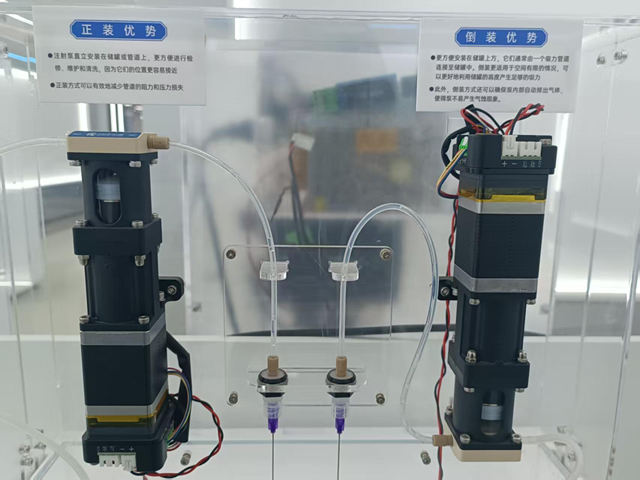
In an upright (needle-up) configuration, the syringe barrel is positioned below the outlet port. The plunger advances upward during dispensing.
In an inverted (needle-down) configuration, the outlet port is located at the lowest point, and the plunger pushes downward during operation.
Although mechanically similar, these two orientations behave very differently under real operating conditions.
Advantages of Upright Installation
1. Superior Bubble Management
One of the most significant advantages of upright syringe pump installation is natural air bubble removal.
Air bubbles are lighter than liquid and rise to the highest point in the system. In the upright orientation, this highest point is the outlet port, allowing bubbles to be purged efficiently during priming.
This makes upright installation ideal for:
Pharmaceutical filling
Micro-volume dosing
Biotech applications
Any process where air contamination is unacceptable
For applications involving aqueous or low-viscosity fluids, upright configuration is generally the safest choice.
2. Easier Priming Process
When fluid is drawn from a reservoir below the pump, the syringe fills from the bottom upward. This fill-from-below behavior naturally pushes air toward the outlet port, enhancing purge efficiency.
As a result, upright syringe pumps are easier to commission and maintain in systems requiring frequent fluid changes.
Disadvantages of Upright Installation
1. Dead Volume and Droplet Formation
Because the outlet is positioned at the top, gravity pulls fluid away from the tip after dispensing.
This can lead to:
Residual droplets
Tip drying or crystallization
Cross-contamination when switching fluids
Minor inconsistencies in the next dispense cycle
For high-value reagents or very small dispense volumes, this dead volume effect may reduce process accuracy.
Advantages of Inverted Installation
1. Minimal Dead Volume and Better Drainage
In inverted installation, the outlet is positioned at the lowest point.
After dispensing:
Fluid drains completely
No hanging droplets remain
Tip drying is minimized
This configuration is especially beneficial when:
Dispensing high-viscosity fluids
Using expensive reagents
Requiring full volume recovery
Operating continuous dispensing systems
For applications demanding maximum material utilization, inverted syringe pump installation is often preferred.
2. Improved Handling of Particulate or Settling Fluids
For fluids containing particles or suspended materials, gravity causes heavier components to settle downward.
In the inverted configuration:
Settled particles are expelled first
Sediment does not accumulate in the barrel
Plunger seals are less likely to be affected
This is particularly useful in:
Cell-laden bio-materials
Conductive inks
Chemical suspensions
Disadvantages of Inverted Installation
1. Challenging Bubble Removal
Bubble management is the primary weakness of inverted syringe pump installation.
Since air rises upward and the outlet is at the bottom, bubbles accumulate at the top of the barrel, away from the exit path.
This trapped air can cause:
Compressibility effects
Delayed fluid response
Reduced dosing precision
“Spongy” dispensing behavior
Removing air often requires:
Degassing procedures
System tilting
Additional priming cycles
For ultra-precision micro-dispensing, this can significantly impact performance.
2. More Difficult Priming
During aspiration in an inverted system, air can become trapped at the upper end of the barrel, forming an air pocket that interferes with normal filling.
Improper priming increases the risk of metering inaccuracies.
Key Comparison: Upright vs. Inverted Syringe Pump Installation
Factor | Upright (Needle-Up) | Inverted (Needle-Down) |
Bubble Removal | Excellent | Difficult |
Dead Volume | Higher | Minimal |
Drainage | Limited | Excellent |
High-Viscosity Fluids | Acceptable | Preferred |
Particulate Fluids | Moderate | Better |
Micro-Volume Accuracy | Very High (if bubble-free) | High (if degassed) |
The optimal syringe pump installation depends on application priorities:
Choose upright installation if:
Bubble elimination is critical
Fluids are low-viscosity
Applications require ultra-precise dosing without compressibility
Choose inverted installation if:
Dead volume must be minimized
Expensive fluids require full recovery
Fluids are viscous or contain particulates
Drip-free operation is essential
In many industrial systems, engineers design additional features—such as suck-back functions, degassing modules, or pressure compensation—to balance the limitations of each configuration.
The choice between upright and inverted syringe pump installation is not merely mechanical—it directly affects dispensing accuracy, bubble behavior, drainage performance, and long-term system reliability.
Upright orientation excels in bubble management and precision dosing.
Inverted orientation offers superior drainage and minimal dead volume.
By understanding the interaction between fluid properties and installation orientation, engineers can significantly improve system performance and process stability in high-precision fluid control applications


 English
 日本語
日本語 한국어
한국어 français
 Deutsch
 Español
 italiano
 русский
 português
 Türkçe
 Nederland