
86-025-5119 7362

Peristaltic pump head is the effective energy increase that the pump gives to a liquid, commonly interpreted in fluid-delivery applications as the highest vertical elevation the pump can support under defined conditions. For an OEM engineer, the important design question is not simply how high a tube can be raised. The calculation must connect pressure difference, liquid density, velocity, and elevation before the result is compared with a tested pump configuration.
This guide shows how to calculate peristaltic pump head from the documented pressure equation, then applies it to a 0.2 MPa water example and a 15 m customer requirement. It also separates theoretical pressure-to-height conversion from reference test data for SN, YZ, and RZ pump configurations.
Quick Answer. When inlet and outlet velocities are approximately equal and only pressure-induced head is being calculated, use H ≈ ΔP/(ρg). For water at ρ = 1,000 kg/m³ and g = 9.8 m/s², 0.2 MPa corresponds to approximately 20.41 m of theoretical head. Reversing the equation, a 15 m water elevation requires approximately 147,000 Pa, or 0.147 MPa. These values are calculation references; final peristaltic pump head must be confirmed with the selected pump head, tubing, and operating setup.
The documented equation treats peristaltic pump head as the sum of pressure head, velocity head, and elevation difference. It is written as:
Total head: H = (p₂ - p₁)/(ρg) + (v₂² - v₁²)/(2g) + z₂ - z₁
Symbol | Engineering meaning | Unit used in the calculation |
H | Peristaltic pump head | m |
p₁, p₂ | Liquid pressure at pump inlet and outlet | Pa |
v₁, v₂ | Liquid velocity at inlet and outlet | m/s |
z₁, z₂ | Inlet and outlet elevation | m |
ρ | Liquid density | kg/m³ |
g | Gravitational acceleration | m/s² |
The pressure term shows how outlet pressure becomes vertical lifting capability. The velocity term accounts for a change in kinetic energy, while the elevation term represents the physical height difference between the inlet and outlet reference points. All units must be consistent before peristaltic pump head is calculated. After calculating the theoretical value, compare it with the tested performance range of a suitable peristaltic pump head and tubing configuration.
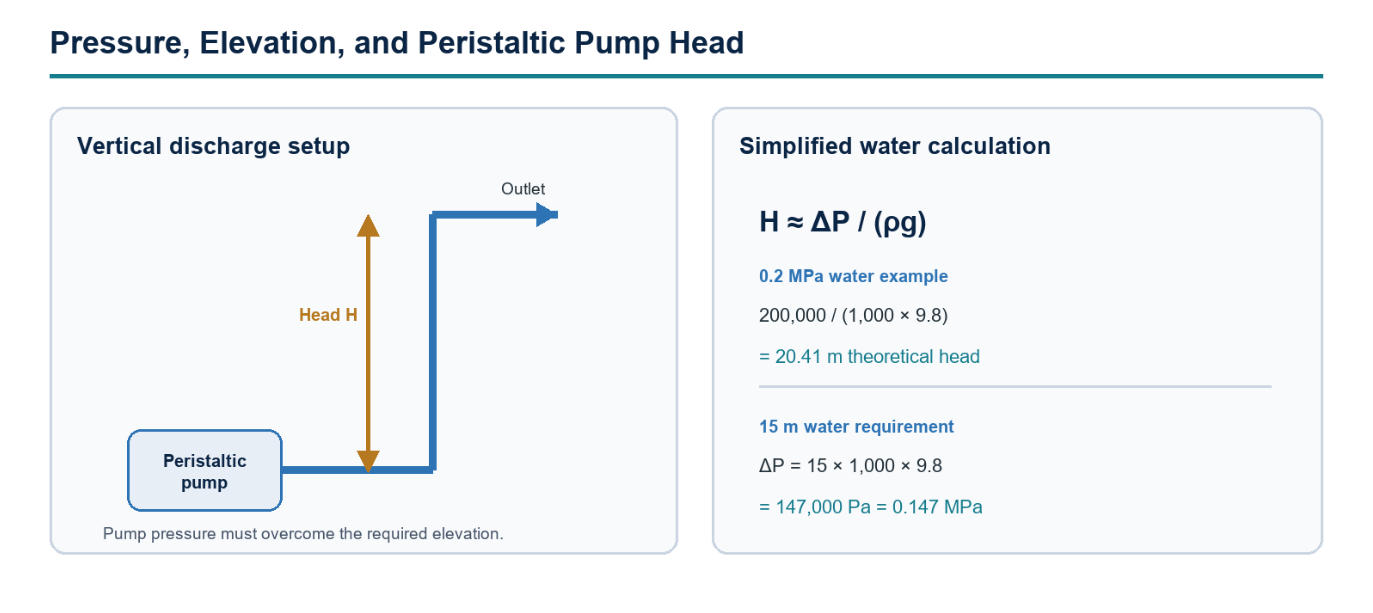
Figure 1. Pressure-to-elevation relationship used to estimate peristaltic pump head for water.
In the documented peristaltic pump calculation, inlet and outlet velocities are treated as approximately equal. Under that condition, the velocity-head difference approaches zero. If the calculation uses the same elevation reference at the pump ports, the pressure-to-head relationship becomes:
Pressure head: H ≈ ΔP/(ρg)
This simplified equation is useful for initial peristaltic pump head screening. It should not be interpreted as a universal operating curve because the result depends on the liquid density and the pressure capability of the actual pump-head and tubing combination.
Worked example: 0.2 MPa water pressure
The YZ-series example uses an outlet pressure difference of 0.2 MPa. Convert 0.2 MPa to 200,000 Pa, use a water density of 1,000 kg/m³, and use g = 9.8 m/s².
Calculated head: H = 200,000 / (1,000 × 9.8) = 20.408 m ≈ 20.41 m
The theoretical peristaltic pump head is therefore approximately 20.41 m for the stated water calculation. The engineering summary reports reference values of up to 20.25 m for SN- and YZ-series configurations and up to 13.5 m for RZ-series configurations. The calculation and the reference value are close but should remain separate in a customer specification.
When the required peristaltic pump head is known, rearrange the pressure-head equation to calculate the required pressure difference.
Required pressure: ΔP = Δz ρ g
For a 15 m vertical requirement with water, the documented example is:
15 m example: ΔP = 15 × 1,000 × 9.8 = 147,000 Pa = 0.147 MPa
The pump-head and tubing combination should therefore be evaluated at a discharge pressure of at least 0.147 MPa for this simplified static water requirement. This number is an input to peristaltic pump head selection, not a final guarantee for an assembled instrument. Where repeatable speed control is important during pressure and elevation testing, a stepper motor peristaltic pump can be evaluated with the selected pump head and tubing.
Item | Condition | Head or pressure result | How to use it |
YZ calculation | Water; ΔP = 0.2 MPa; ρ = 1,000 kg/m³; g = 9.8 m/s² | 20.41 m theoretical head | Initial pressure-to-height calculation |
SN and YZ reference | Documented pump-series summary | Up to 20.25 m | Reference value for configuration screening |
RZ reference | Documented pump-series summary | Up to 13.5 m | Reference value for configuration screening |
Customer requirement | Water; vertical lift = 15 m | 0.147 MPa required pressure | Minimum simplified pressure requirement |
A theoretical peristaltic pump head calculation answers what pressure means in metres of liquid. A reference value answers what was recorded for a pump series or pump-head arrangement. Use both, but do not replace one with the other.
The documented tubing comparison records a 20 m head with #14 tubing at 1.6 mm inner diameter and a 19 m head with #16 tubing at 3.2 mm inner diameter. The #16 cross-sectional area is four times the #14 area, while the recorded peristaltic pump head decreased by approximately 1 m in that comparison. Because the actual result also depends on tube material and wall structure, silicone tubing for peristaltic pump should be evaluated together with the selected inner diameter.
Tubing | Inner diameter | Relative cross-sectional area | Recorded head |
#14 | 1.6 mm | 1× reference | 20 m |
#16 | 3.2 mm | 4× the #14 area | 19 m |
This two-point result is useful as an application observation, but it is not enough to create a universal equation between tubing diameter and peristaltic pump head. Use the tested pair only as a comparison and validate any other tube size directly.
1. Define the actual vertical distance between the liquid source and the highest outlet point.
2. Record the liquid density used in the pressure-to-head calculation.
3. Use the full head equation when inlet and outlet velocity or elevation terms cannot be neglected.
4. Calculate the required pressure with ΔP = Δzρg for the simplified static case.
5. Compare the pressure requirement with the documented pump-series or pump-head reference value.
6. Select the actual tubing model and inner diameter, then verify that the peristaltic pump tubing connectors are compatible with the tubing and the rest of the fluid path.
7. Verify delivery at the required height and record the test conditions with the final result.
For compact analytical equipment, the calculated head requirement can then be matched with a micro peristaltic pump and the selected tubing configuration. Following this sequence keeps peristaltic pump head separate from unrelated flow-rate assumptions. An application can meet its flow target at low elevation yet fail when the outlet is raised, so the pressure requirement must be validated independently.
· Using MPa directly in a formula that expects pascals.
· Using liquid density in g/cm³ without converting the rest of the equation.
· Treating theoretical peristaltic pump head as a guaranteed installed-system height.
· Ignoring the difference between a pump-series reference and a specific pump-head and tube configuration.
· Applying the two-point #14/#16 tubing observation to every available tube size.
· Changing tubing without repeating the required-height validation.
What is peristaltic pump head?
It is the effective head added to the liquid by the pump. In a vertical delivery application, it is commonly used to describe the highest liquid elevation supported under defined conditions.
How do I convert pressure to peristaltic pump head?
Use H ≈ ΔP/(ρg) when inlet and outlet velocities are approximately equal and the pressure-head term is the required calculation.
What peristaltic pump head corresponds to 0.2 MPa for water?
Using ρ = 1,000 kg/m³ and g = 9.8 m/s², the theoretical result is approximately 20.41 m.
What pressure is required for a 15 m water lift?
The simplified calculation gives 147,000 Pa, or 0.147 MPa.
Do SN and YZ pumps always provide 20.25 m head?
No. The 20.25 m value is a documented reference summary. Final performance must be confirmed with the selected pump head, tubing, and operating setup.
Does larger tubing always reduce peristaltic pump head?
The documented comparison recorded 20 m with 1.6 mm I.D. #14 tubing and 19 m with 3.2 mm I.D. #16 tubing. Two points do not define a universal rule for all tube sizes.
Can the same head calculation be used for liquids other than water?
The equation can be used when the actual liquid density and consistent units are entered. The water examples should not be copied without changing density.
Peristaltic pump head should be calculated from pressure, density, velocity, and elevation before it is compared with reference pump data. For the documented water examples, 0.2 MPa corresponds to approximately 20.41 m of theoretical head, while a 15 m lift requires approximately 0.147 MPa. The SN and YZ summary value of up to 20.25 m and the RZ value of up to 13.5 m remain configuration references, not universal guarantees.
For an OEM design, the final peristaltic pump head result must be verified with the actual pump head, tubing inner diameter, liquid, and installed elevation. A calculation establishes the requirement; a controlled application test establishes whether the selected configuration meets it.



 English
 日本語
日本語 한국어
한국어 français
 Deutsch
 Español
 italiano
 русский
 português
 Türkçe
 Nederland