
86-025-5119 7362

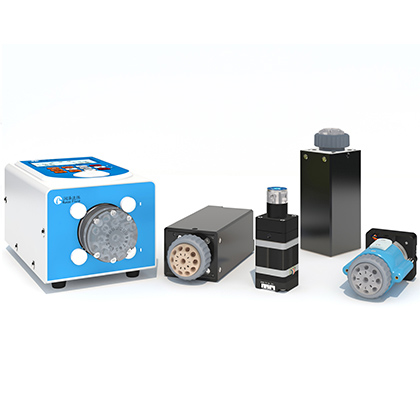
Peristaltic pump tubing size is a primary input to flow-rate selection because the documented relationship makes flow proportional to the square of tube radius and to pump speed. A small change in inner diameter can therefore produce a large change in calculated flow when the pump-head coefficient and speed remain fixed.
This guide explains how to select peristaltic pump tubing size with Q = kr²N, how to rearrange the equation for speed or radius, and how to keep units consistent. Two documented examples are used: 35 mL/min with an RZ1030B four-roller pump head and 360 mL/min with a YZ1515 three-roller pump head.
Quick Answer. Use Q = kr²N when the pump-head coefficient k has already been established for the selected pump head and the application remains within its valid head range. To find speed, use N = Q/(kr²). To find tubing radius, use r = √[Q/(kN)], then calculate inner diameter with d = 2r. In the documented examples, a 1.42 mm I.D. tube required about 300 rpm for 35 mL/min on an RZ1030B four-roller head, while a 360 mL/min target at 400 rpm on a YZ1515 three-roller head produced a calculated 3.16 mm I.D., leading to selection of #16 tubing at 3.2 mm I.D. |
The documented relationship between flow, tubing radius, and speed is:
Flow relationship: Q = k r² N
Symbol | Meaning | Unit used in the examples |
Q | Flow rate | mL/s |
k | Pump-head-specific derived coefficient | Coefficient for the selected pump head |
r | Tubing inner radius | cm |
N | Rotational speed | rpm |
d | Tubing inner diameter, where d = 2r | cm or converted to mm |
The coefficient k is not universal. It changes with the pump head and is stated to be applicable only within the peristaltic pump head range used to derive it. A peristaltic pump tubing size calculation is valid only when the correct coefficient is paired with the correct pump-head configuration.
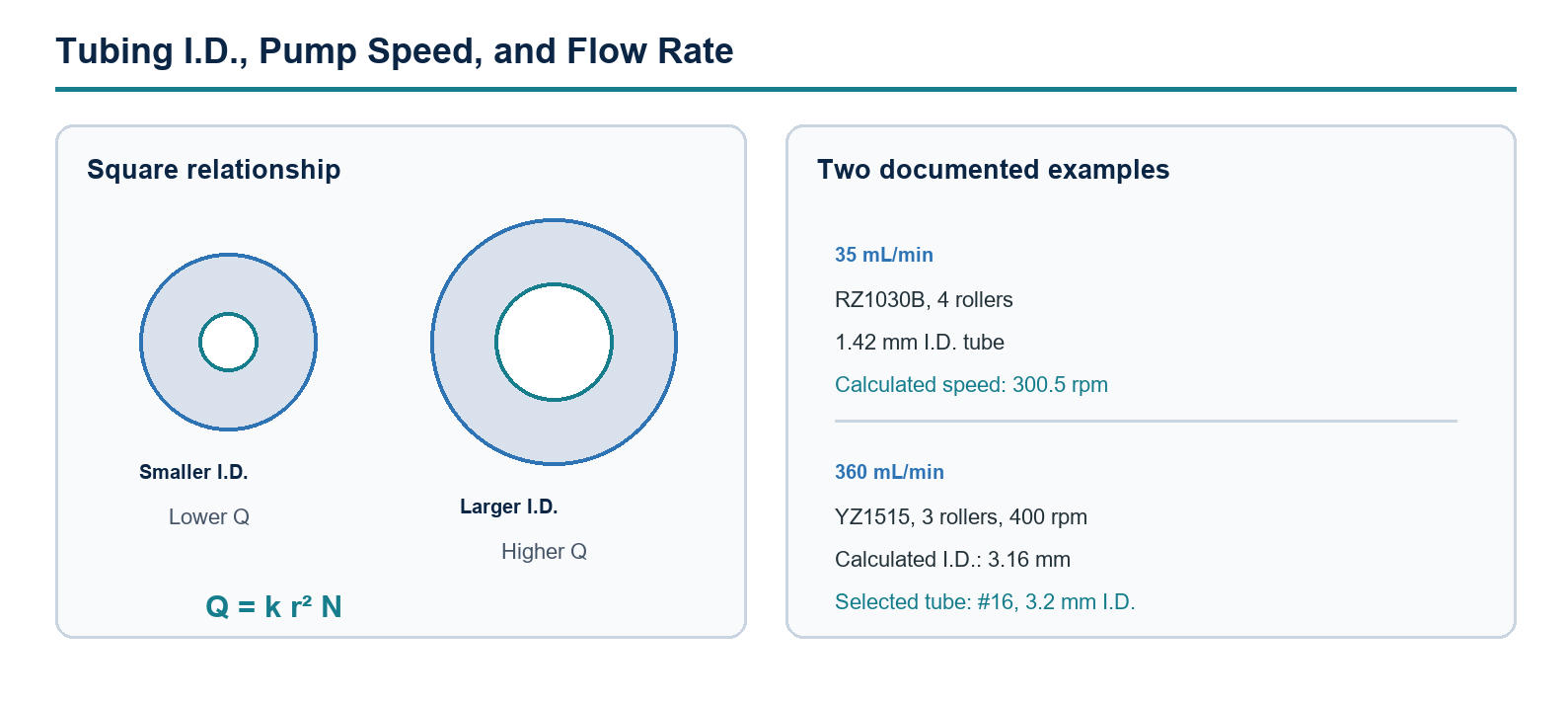 Figure 1. Peristaltic pump tubing size affects calculated flow through the square of the tube radius.
The same relationship can answer three different selection questions. Keep Q in mL/s and r in cm when using the documented coefficients.
Calculate flow: Q = k r² N
Calculate speed: N = Q / (k r²)
Calculate radius: r = √[Q / (kN)]
Calculate inner diameter: d = 2r
Known inputs | Unknown | Use this form | Selection outcome |
Pump head, tubing, speed | Flow Q | Q = kr²N | Estimate flow for an existing configuration |
Pump head, tubing, target flow | Speed N | N = Q/(kr²) | Set a starting rotational speed |
Pump head, target flow, speed | Radius r | r = √[Q/(kN)] | Select a tubing inner diameter |
The first peristaltic pump tubing size example uses an RZ1030B four-roller pump head and tube model 0142-008. The tube inner diameter is 0.142 cm, or 1.42 mm, and wall thickness is 0.8 mm. The target flow is 35 mL/min.
1. Convert the flow rate
Flow conversion: Q = 35 / 60 = 0.583 mL/s
2. Calculate tubing radius squared
Tube geometry: r = 0.142 / 2 = 0.071 cm; r² = 0.005041 cm²
3. Calculate speed with k = 0.385
Required speed: N = 0.583 / (0.385 × 0.005041) = 300.5 rpm
The documented starting setting is therefore approximately 300 rpm. This result demonstrates how a known peristaltic pump tubing size can be used to calculate speed for a required flow. The calculation should be verified by measuring the delivered flow in the assembled system.
Worked Example: 360 mL/min with YZ1515
The second example starts with a target flow and speed, then calculates peristaltic pump tubing size. The pump head is a YZ1515 three-roller configuration, target flow is 360 mL/min, and selected speed is 400 rpm. The pump-head-specific coefficient used in the original calculation produces a radius of 0.158 cm.
Flow conversion: Q = 360 / 60 = 6 mL/s
Calculated radius: r = 0.158 cm
Calculated inner diameter: d = 2r = 0.316 cm = 3.16 mm
The nearest documented tubing selection is #16 tubing with a 3.2 mm inner diameter. The calculation narrows the selection, while the final peristaltic pump tubing size should be validated at the target 400 rpm and 360 mL/min condition.
Item | RZ1030B example | YZ1515 example |
Pump head | Four-roller RZ1030B | Three-roller YZ1515 |
Target flow | 35 mL/min | 360 mL/min |
Known tubing or speed | Tube 0142-008; 1.42 mm I.D.; 0.8 mm wall | 400 rpm |
Coefficient | k = 0.385 | Pump-head-specific coefficient used in the documented calculation |
Calculated result | 300.5 rpm; use approximately 300 rpm | 3.16 mm I.D. |
Selected tubing | Already defined as 0142-008 | #16 tubing; 3.2 mm I.D. |
The examples use different pump heads and therefore should not share the same k value. This is the most important boundary in peristaltic pump tubing size calculations: identify the pump head before using a coefficient.
Because Q is proportional to r², the calculated flow changes with the square of tubing radius when k and N remain fixed. Doubling radius increases the theoretical cross-sectional term by four times. Halving radius reduces it to one quarter. This relationship explains why peristaltic pump tubing size cannot be treated as a minor mechanical detail.
Radius change | r² relationship | Calculated flow relationship at fixed k and N |
0.5× radius | 0.25× r² | 0.25× calculated flow |
1× radius | 1× r² | 1× calculated flow |
2× radius | 4× r² | 4× calculated flow |
These ratios are direct mathematical consequences of Q = kr²N. They are not substitutes for a new pump-head calibration when the tube, pump head, or operating range changes.
1. Identify the exact pump-head type and roller configuration.
2. Confirm that a valid coefficient k is available for that pump head and operating range.
3. Convert the target flow from mL/min to mL/s before using the documented formula.
4. Choose whether flow, speed, or tubing inner radius is the unknown variable.
5. Calculate radius in centimetres, then convert inner diameter to millimetres for tube selection.
6. Select the closest available tubing model without silently changing the calculated units.
7. Measure delivered flow at the calculated speed and record the actual configuration.
This workflow makes peristaltic pump tubing size selection reproducible. It also prevents a coefficient derived for one pump head from being reused on another head simply because the target flow is similar.
· Entering mL/min directly when the formula example uses mL/s.
· Using tubing diameter where the equation requires radius.
· Using millimetres in a calculation where r is defined in centimetres.
· Reusing k across different pump-head types or roller configurations.
· Applying the equation outside the head range for which k was derived.
· Selecting the nearest commercial tube but not measuring the resulting flow.
What formula is used to select peristaltic pump tubing size?
Use Q = kr²N, where Q is flow in mL/s, r is tube inner radius in cm, N is speed in rpm, and k is the coefficient for the selected pump head.
How do I calculate speed for a known tube size?
Use N = Q/(kr²). Convert flow to mL/s and tubing inner diameter to radius in centimetres before calculating.
How do I calculate tubing inner diameter from flow?
Use r = √[Q/(kN)], then calculate d = 2r and convert the result from centimetres to millimetres.
Is the coefficient k the same for every peristaltic pump head?
No. The documented guidance states that k differs between pump heads and is valid only within the applicable head range.
What peristaltic pump tubing size was selected for 360 mL/min at 400 rpm?
The calculated inner diameter was 3.16 mm, and #16 tubing with a 3.2 mm inner diameter was selected for the documented YZ1515 example.
What speed was calculated for 35 mL/min with 1.42 mm I.D. tubing?
The RZ1030B four-roller example calculated 300.5 rpm and used approximately 300 rpm.
Does doubling tube diameter always quadruple measured flow?
The formula predicts a fourfold change in the r² term when radius doubles at fixed k and N. Actual delivered flow still requires validation with the selected configuration.
Peristaltic pump tubing size should be selected with the pump-head-specific relationship Q = kr²N, consistent units, and a measured validation step. In the documented examples, 1.42 mm I.D. tubing on an RZ1030B four-roller head required approximately 300 rpm for 35 mL/min, while the YZ1515 calculation for 360 mL/min at 400 rpm produced a 3.16 mm inner diameter and led to selection of #16 tubing at 3.2 mm I.D.
For OEM equipment, the correct peristaltic pump tubing size is the one calculated with the right coefficient and then confirmed in the actual pump-head configuration. The formula is a selection tool; the measured flow is the acceptance result.



 English
 日本語
日本語 한국어
한국어 français
 Deutsch
 Español
 italiano
 русский
 português
 Türkçe
 Nederland