
86-025-5119 7362

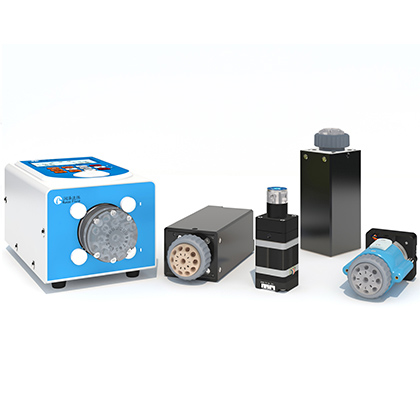
Maintaining a stable flow at a very low rate is one of the more demanding tasks for a syringe pump. When only a small volume of liquid needs to be delivered over a relatively long period, even a slight change in plunger movement, mechanical resistance, vibration, or downstream pressure can become visible in the actual output. The issue is therefore not simply whether a pump can move a syringe slowly, but whether it can control that movement consistently.
The basic syringe pump working principle is straightforward: a motor-driven mechanism advances the syringe plunger at a controlled rate, forcing a defined volume of fluid through the outlet. However, the quality of low-flow delivery depends on everything between the motor command and the fluid leaving the syringe. Syringe dimensions, drive resolution, mechanical transmission, fluid viscosity, tubing resistance, and pressure conditions all have a role to play.
Understanding how syringe pump works at the mechanical and fluidic levels makes it easier to explain why some systems maintain a remarkably smooth flow while others show small fluctuations, particularly when operating toward the lower end of their flow range.
The plunger is where the mechanical movement of the pump becomes actual fluid displacement. In the syringe pump working principle, the drive mechanism pushes the plunger forward by a controlled distance. The amount of liquid displaced depends on the internal geometry of the syringe, while the rate at which the plunger moves determines the volumetric flow rate.
At higher flow rates, a small mechanical variation may represent only a small proportion of the total output. At very low flow rates, the same variation can have a much greater relative effect. This is why smooth and repeatable plunger movement is particularly important for applications involving microfluidic systems, analytical instruments, laboratory dosing, and other precision fluid-handling processes.
The controller must translate the desired flow rate into appropriate motor movement, while the mechanical transmission must convert that rotation into predictable linear displacement. If the plunger hesitates, moves unevenly, or responds differently under changing load conditions, the resulting fluid flow can deviate from the programmed value.
This is also why how syringe pump works cannot be understood simply by looking at its motor. The motor, transmission, plunger mechanism, and syringe form one motion system, and the performance of each part affects the final delivery.
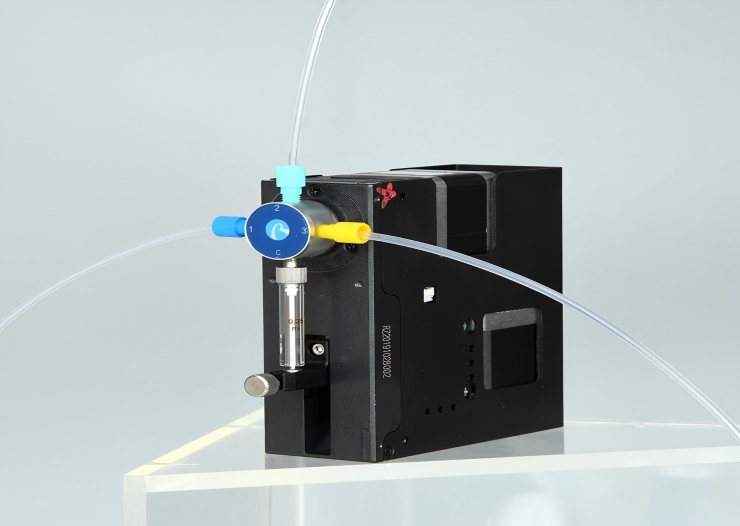
Syringe selection has a direct influence on how a pump behaves at low flow rates. The internal diameter of the syringe determines how much liquid is displaced when the plunger moves a certain distance. As a result, changing syringe size changes the relationship between linear plunger movement and volumetric delivery.
A smaller syringe generally provides finer control over small delivered volumes because its internal cross-sectional area is smaller. However, it also has a lower total capacity. A larger syringe can deliver more fluid before requiring replacement or refilling, but the drive system must be capable of providing the appropriate plunger resolution for the intended flow range.
| Consideration | Smaller Syringe | Larger Syringe |
|---|---|---|
| Available fluid volume | Lower | Higher |
| Plunger displacement required for a given volume | Generally greater | Generally smaller |
| Suitability for very small delivered volumes | Often advantageous | Depends more strongly on drive resolution |
| Primary selection concern | Fine delivery and available capacity | Capacity and appropriate positioning resolution |
There is therefore no universally correct syringe size for low-flow operation. The appropriate choice depends on the required flow range, delivery volume, fluid characteristics, pressure conditions, and the resolution of the pump's drive system.
For this reason, a syringe should not be selected only according to its physical capacity. It should be considered as part of the entire pump configuration. This relationship is an important part of understanding how syringe pump works in an actual application.
The motor provides the motion, but the transmission determines how effectively that motion becomes controlled plunger displacement. Depending on the design, a syringe pump may use a combination of a motor, lead screw, coupling, bearings, and other mechanical components to generate precise linear movement.
Motor resolution is important because the system needs to make sufficiently small positioning changes to maintain the desired flow. However, motor resolution by itself does not guarantee stable output. Mechanical transmission accuracy, screw pitch, positioning repeatability, friction, preload, and controller performance can all influence the movement ultimately seen by the syringe plunger.
For low-flow applications, these details become increasingly important. If the smallest practical movement of the drive system is relatively large compared with the required plunger displacement, the pump may produce noticeable variations instead of a smooth delivery profile. A well-designed system therefore matches the motor and transmission characteristics to the intended operating range.
The same principle applies to acceleration and deceleration. Abrupt changes in motor movement can introduce mechanical disturbance or pressure changes, whereas appropriately controlled motion allows the plunger to transition more smoothly into its target speed.
This illustrates an important point about the syringe pump working principle: stable flow is the result of coordinated mechanical and electronic control, rather than motor resolution alone.
Mechanical backlash is one possible source of instability, particularly when the drive changes direction or makes very small positioning adjustments. If there is clearance between mating components, part of the motor movement may initially be used to take up that clearance instead of moving the plunger. At higher flow rates this may be difficult to notice, but at very low rates it can become significant.
Vibration can create a similar problem. The motor, transmission components, mounting structure, and surrounding equipment can all introduce mechanical vibration. If that vibration reaches the syringe or plunger, it may produce small pressure variations or unwanted movement.
A stable mechanical structure therefore matters just as much as the electronic control system. Proper alignment, rigid mounting, suitable transmission components, and careful control of motor acceleration can reduce unnecessary mechanical disturbance.
Changes in load can also affect the system. When downstream resistance increases, the plunger needs to generate greater force to maintain its movement. If the fluid path contains restrictive tubing, narrow fittings, filters, or other components that create significant resistance, the mechanical behavior of the pump may change under load.
Understanding how syringe pump works therefore requires considering not only commanded movement but also how the mechanical system responds to the actual force required to move the fluid.
A syringe pump can provide highly controlled mechanical movement and still produce inconsistent fluid delivery if the fluid system is poorly matched to the application. Fluid viscosity is one of the most important variables. A more viscous liquid generally requires greater pressure to move through the same tubing and fittings than a lower-viscosity liquid.
This becomes particularly relevant when the outlet path is long, narrow, or contains multiple restrictions. Pressure generated by the syringe plunger may cause flexible tubing to expand slightly before the fluid moves through the system. When the stored mechanical energy is released, the fluid can continue moving even though the plunger has already changed its movement.
Air bubbles create another common source of instability. Unlike most liquids used in fluid-handling applications, air is highly compressible. When a syringe contains trapped air, some of the plunger displacement may initially compress the air instead of immediately delivering liquid. The compressed air can then expand later, producing delayed or fluctuating output.
Temperature can also influence performance because changes in temperature may alter fluid viscosity and, in some applications, the dimensions or mechanical properties of system components. For demanding low-flow applications, controlling the fluid path and operating environment can therefore be just as important as selecting the pump itself.
This is why the syringe pump working principle should always be considered together with the characteristics of the liquid and the downstream system. A pump does not operate independently from the fluid path connected to it.
When a syringe pump cannot maintain a stable low flow, the first step is to determine whether the fluctuation originates from the pump, the syringe, or the surrounding fluid system. A syringe that is incorrectly installed or has excessive plunger friction can create resistance that affects delivery. The syringe should fit the pump properly, and the plunger should move without abnormal mechanical interference.
The drive mechanism should then be examined. Unusual vibration, inconsistent motor movement, mechanical noise, or excessive play may indicate problems with the transmission or mounting. If the pump allows motion parameters such as acceleration and deceleration to be adjusted, these settings should also be reviewed against the requirements of the application.
The fluid path is equally important. Check whether there is trapped air in the syringe or tubing, whether fittings are leaking, and whether any part of the system is partially blocked. Tubing that is excessively flexible or restrictive can also influence the relationship between plunger movement and actual fluid delivery.
It is also important to verify that the selected syringe and pump configuration are appropriate for the target flow range. Operating close to the limits of a system can produce very different results from operating within the range for which the pump and syringe combination was designed.
Runze Fluid approaches syringe pump selection from this application perspective rather than treating flow rate as an isolated specification. When comparing different fluid-handling configurations, reviewing the available Runze Fluid products can help users understand how different pump solutions correspond to different dosing and fluid-control requirements.
For applications where the required flow is particularly low or where fluid resistance and pressure conditions are difficult to define in advance, discussing the actual operating conditions with the manufacturer can prevent an unsuitable configuration from being selected. The Runze Fluid technical team can evaluate factors such as syringe size, target flow range, fluid characteristics, tubing conditions, and operating requirements when discussing a specific application.
A syringe pump achieves stable low-flow delivery by controlling syringe plunger movement with sufficient precision and repeatability. Although the basic syringe pump working principle is simple, reliable performance at low flow rates depends on the interaction between the motor, transmission mechanism, syringe geometry, control resolution, fluid properties, and downstream pressure.
Understanding how syringe pump works also explains why low-flow stability cannot be judged by motor specifications or maximum flow rate alone. Mechanical backlash, vibration, syringe selection, air bubbles, fluid viscosity, tubing resistance, and pressure changes can all influence the actual output. For precision applications, the pump and fluid path need to be considered as one system.
When these factors are properly matched, a syringe pump can provide the controlled and repeatable delivery required for laboratory research, analytical instrumentation, microfluidics, pharmaceutical development, and other precision fluid-handling applications.
A syringe pump controls the linear movement of the syringe plunger. By regulating this movement with appropriate motor and drive resolution, the pump can maintain a controlled volumetric delivery rate.
At a very low flow rate, even a small amount of unwanted plunger movement or mechanical vibration can represent a relatively large change compared with the intended delivery rate.
Yes. Syringe diameter determines how much fluid is displaced by a given amount of plunger movement. The syringe should therefore be matched to the required flow range and the positioning resolution of the pump.
Yes. Air can be compressed by plunger movement, temporarily storing pressure instead of immediately displacing liquid. Its subsequent expansion can cause delayed or uneven delivery.
No. Motor resolution is only one factor. Transmission accuracy, mechanical backlash, screw characteristics, controller resolution, syringe geometry, and fluid-system resistance also influence the final flow.
Check the syringe installation, plunger friction, drive mechanism, mechanical vibration, air bubbles, tubing restrictions, leaks, fluid viscosity, downstream pressure, and whether the selected pump configuration is appropriate for the required flow range.


 English
 日本語
日本語 한국어
한국어 français
 Deutsch
 Español
 italiano
 русский
 português
 Türkçe
 Nederland