
86-025-5119 7362

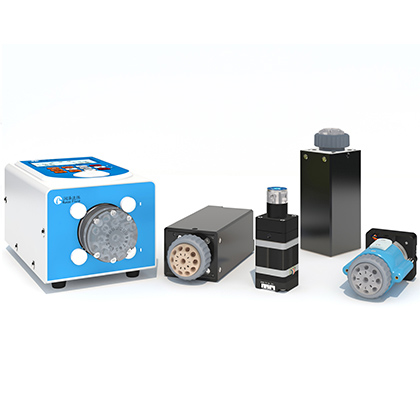
A dual pump head peristaltic pump can simplify two-channel dispensing because one motor drives two pump heads at the same commanded speed. That shared drive does not automatically make the delivered masses identical. Tube dimensions, tube seating, occlusion, inlet conditions, outlet resistance, wear, and measurement method can create channel-to-channel differences. A RUNZE laboratory report for a BJ30 with two YZ1515X heads provides a useful worked example: five 5-second pure-water test points produced paired masses from about 15.9 g to 25.5 g. This article explains what those measurements support, what they do not prove, and how an OEM should convert the method into an application-specific acceptance test.
Quick answer: The report shows closely paired outputs for one BJ30-YZ1515X-3H-DD sample under a short, pure-water laboratory test. Using absolute channel difference divided by the pair average, the five reported mass pairs differ by approximately 0.15% to 0.71%. This supports feasibility for matched two-channel delivery under the tested setup, but it is not a universal accuracy or long-term consistency guarantee. Repeat the test with the production tubing, liquid, routing, backpressure, cycle time, and aging condition.
The test report identifies one BJ30-YZ1515X-3H-DD unit, serial number RY021513349. The medium was pure water at 20 +/- 2 degrees C and 45% to 75% RH. The drive supply was 24 VDC, and SerialComm V1.3.0 Release was listed as the debugging tool. The tubing set included Pharmed BPT-0480-016 (25#) tubing, 0.36 m long, and 96402-25 silicone tubing, 0.8 m long, with two DI-064 equal-bore straight PP connectors.
The stated method was to mount two heads in parallel, tighten the fasteners, connect and prefill the tubing, command five speed points - 110, 130, 150, 160, and 170 rpm - and measure the output from each head over five seconds. The report includes five paired mass results. This is a short channel-matching test for a specific assembly; it is not a multi-unit capability study, an absolute volumetric calibration, or an endurance test.
The table below reproduces the reported masses and calculates pair difference as |outer - inner| divided by the average of the two masses, multiplied by 100. The source report does not state the percentage formula, so the calculated column is an editorial calculation, not a value copied from the report. Because the liquid was pure water, mass is a convenient comparison signal; this article does not convert the measurements to volume because the report does not state the water temperature at weighing, balance details, or density correction method.
Planned test point | Outer head | Inner head | Absolute difference | Calculated pair difference |
110 rpm | 15.866 g | 15.954 g | 0.088 g | 0.553% |
130 rpm | 18.921 g | 18.893 g | 0.028 g | 0.148% |
150 rpm* | 21.913 g | 21.978 g | 0.065 g | 0.296% |
160 rpm* | 23.535 g | 23.702 g | 0.167 g | 0.707% |
170 rpm* | 25.323 g | 25.462 g | 0.139 g | 0.547% |
*Reporting limitation: the method lists 150, 160, and 170 rpm as the final three planned points, but the conclusion text repeats '110 rpm' on those three mass lines. The mapping shown above follows the sequence of the stated method and should be confirmed against the original test record or video before external publication of speed-specific results.
This recalculation also explains why the source should be presented with raw data. A related sales-experience summary describes the deviation as within 0.5%, but three pairs are about 0.55%, 0.71%, and 0.55% under the symmetric average-denominator formula. Another denominator could produce a different percentage. The engineering response is not to choose the most favorable formula after the test; it is to define the formula and acceptance limit in the protocol before collecting data.
Two channels can match each other closely while both are above or below the target dose. Conversely, one channel can be close to target while the other is not. A complete dispensing validation therefore needs at least two metrics: absolute error against the commanded target and channel-to-channel difference. The BJ30 report focuses on the second question and does not list a target mass for each speed. Absolute delivery error for these five points is therefore not available in the source documents.
Metric | Question answered | Required reference |
Channel difference | Do the two outlets deliver similar amounts? | Average or designated reference channel |
Absolute error | Does each outlet meet the commanded amount? | Defined target mass or volume |
Repeatability | Does each channel reproduce its result? | Multiple repeated cycles per condition |
Long-term drift | Does matching change with tube aging? | Baseline and scheduled life checkpoints |
A shared motor removes one source of speed mismatch, but each fluid path still contains independent tolerances. Peristaltic delivery depends on the volume displaced as rollers compress and release the tube. Small differences in tube inner diameter, wall thickness, elastic recovery, and installed tension can change delivered mass. Head occlusion, roller condition, and tube position influence how fully the line closes and refills. Even nominally identical outlet tubing can see different resistance if one path is longer, rises higher, contains a tighter fitting, or has a different nozzle wetting condition.
Tube lot and cut length: use matched production material and document lot traceability.
Installation: seat both tubes using the same procedure and verify that clamps and covers are fully engaged.
Priming: remove trapped gas and use a defined pre-run volume or time before measurement.
Hydraulic symmetry: match inlet level, outlet height, fittings, tube length, and downstream restriction.
Measurement: use separate calibrated vessels, a suitable balance, synchronized timing, and evaporation controls where relevant.
Aging: test new tubes and representative aged tubes because peristaltic tubing changes under repeated compression.
The RUNZE catalog describes the BJ30 as a 57-stepper-motor peristaltic pump family compatible with SN, YZ, and FG-16 heads. The BJ30-YZ1515X versions accept 14#, 16#, 25#, and 17# tubing and are listed for speeds up to 400 rpm. Catalog water-flow values are explicitly marked as references measured at normal temperature and pressure. For YZ1515X-3, the catalog lists reference flows of 117, 389, 752, and 1249 mL/min for the four tubing sizes at 400 rpm. Those catalog values are not interchangeable with the five-second paired masses in the test report because the exact tubing circuit and purpose differ.
The YZ1515X head is described as an easy-load design with an ABS housing and 304 stainless-steel rollers, and it can be used as two heads in series on one drive. The relevant tested part is the black three-roller YZ1515X-3H configuration. The catalog provides useful selection boundaries, but it does not provide a guaranteed two-head matching tolerance across tube lots, pressures, liquids, or service life. Data not available in source documents.
1. Write the metric first. Define absolute error, channel difference, repeatability, sample count, calculation formula, and acceptance limits before testing.
2. Build the production-representative fluid path. Use the intended tube material and size, connectors, lengths, reservoir level, outlet height, nozzle, and downstream restriction.
3. Test the real liquid or a justified surrogate. Pure water is not a substitute for a viscous, foaming, volatile, particle-containing, or non-wetting process liquid without evidence.
4. Standardize installation and priming. Record how the tube is loaded, how long the pump pre-runs, and how bubbles are detected or rejected.
5. Measure several repeats per speed and dose. One pair at each condition cannot characterize repeatability or a distribution.
6. Include boundary conditions. Test minimum and maximum speed, shortest dose, highest expected outlet resistance, minimum reservoir level, and relevant ambient temperatures.
7. Add life checkpoints. Compare new tubing with tubing aged by the expected compression cycles or operating hours, and define replacement criteria.
8. Control reporting. Preserve raw masses, timestamps, balance identification, tube lot, pump serial number, calculation sheet, and any excluded runs.
A shared dual-head drive is a reasonable architecture when two channels should run simultaneously at the same nominal speed, the fluid paths can be made symmetric, and any residual difference can be accepted or calibrated. It is less suitable when each channel requires independent timing, independent direction, substantially different flow rates, or closed-loop correction. The source report does not compare the dual-head configuration with two independently driven pumps, so cost, control complexity, and achievable correction should be evaluated in the target instrument.
Selection checkpoint: If the specification says only 'two equal channels,' convert that phrase into a numerical acceptance limit, a calculation formula, a liquid, a tube age, and a pressure condition. Without those definitions, supplier and customer can both test correctly and still reach different conclusions.
Not under every common calculation. Using absolute difference divided by the pair average, the five raw pairs calculate to about 0.15% to 0.71%. The acceptance formula should be agreed before testing.
No. The report lists pure water. A different liquid should be tested when viscosity, wetting, foaming, volatility, particles, or chemical compatibility could affect delivery.
The report lists one BJ30-YZ1515X-3H-DD sample. It does not establish unit-to-unit capability across a production population.
No. The report compares paired five-second masses and does not state a target mass for absolute error. Use a separate calibration protocol for commanded flow or dose.
The method lists 110, 130, 150, 160, and 170 rpm, while the conclusion repeats 110 rpm on the last three lines. The assumed sequential mapping should be checked against the original record.
No. One motor aligns commanded rotational speed, but tubing, occlusion, priming, hydraulic resistance, wear, and measurement still affect each channel independently.
Repeat channel-difference, absolute-error, repeatability, boundary-condition, and aged-tube tests with production hardware and the real liquid or a justified surrogate.
A dual pump head peristaltic pump can be a compact way to create two simultaneous channels, and the BJ30 pure-water report provides encouraging paired data for one defined setup. Its strongest value is methodological: it shows how a customer concern can be converted into measured channel outputs. Its limits are equally important. The report covers one sample, one tubing arrangement, pure water, five short test points, and no repeated-cycle statistics. Use the raw values transparently, resolve the speed-label inconsistency, define the percentage formula in advance, and reproduce the test with the final fluid path before making a production-level consistency claim.


 English
 日本語
日本語 한국어
한국어 français
 Deutsch
 Español
 italiano
 русский
 português
 Türkçe
 Nederland