
86-025-5119 7362

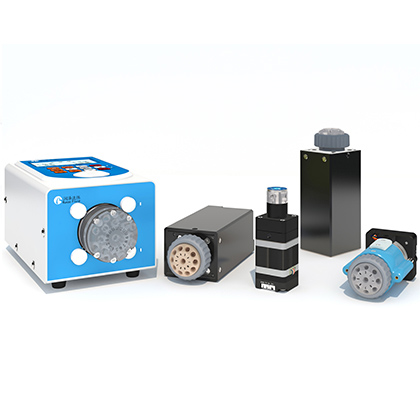
Peristaltic pump startup flow validation helps equipment builders decide whether the first delivery after a defined idle period meets the same acceptance criteria as later deliveries. For a RUNZE RZ-02 installation, that decision should come from measurements on the intended assembly. A report title mentioning warmup does not establish a mandatory warmup duration, a universal stabilization period, or a guaranteed improvement in accuracy.
This guide examines the RZ-02 test report RZSY24012401, dated January 24, 2024. It explains what the recorded five-minute collections support, what remains unresolved, and how to turn the evidence into a useful qualification plan. The focus is startup behavior and repeatability, rather than general tubing selection or troubleshooting a pump that cannot prime.
The available RZ-02 report records ten five-minute collections at 200 rpm on one RZ02-1.6-6-Z unit. The collected volumes range from 408 to 422 mL, with a calculated mean of 413.9 mL. Dividing that mean by five minutes gives an interval-average flow of 82.78 mL/min. These values describe the recorded test series; they are not a product-wide accuracy specification.
The method explicitly starts with testing without preheating, despite the report's warmup title. It does not provide a clearly labeled paired comparison before and after a defined warmup. For the required warmup duration and the resulting improvement: Data not available in source documents. Qualify the startup condition directly before making either claim in an equipment specification.
Define startup in operational terms. It might mean the first dispense after overnight inactivity, the first run after replacing tubing, or restarting after a short production pause. These are proposed test conditions, not conditions documented by the historical report. Select the situations that actually occur in the instrument and record them separately. Otherwise, repeated measurements may answer different questions while appearing to belong to one dataset.
Separate priming from any proposed warmup. The source method says to fill the tubing before testing. It does not establish the behavior of an initially empty fluid path. Accordingly, its collected-volume results should not be used as proof that the first delivery from an empty line meets a dose requirement. Record whether the line is filled, how that state was established, and where the accepted collection starts.
Also define the measurement boundary. A five-minute collection measures the total received during that interval. It does not resolve the first few seconds or the variation within the interval. If the instrument uses short doses, test those doses directly. A successful five-minute average cannot by itself establish the acceptance of every brief delivery contained within that period.
The report identifies one RZ02-1.6-6-Z pump and an MC-21C driver in the method. The recorded supply is DC 24 V, with ambient temperature of 20 ± 2 °C and relative humidity of 45 to 75 percent. These are test conditions. They should not be restated as the full operating limits of every RZ-02 configuration.
The listed fluid path includes a 10 cm Pharmed BPT-0320-016 pump tube, two DI-032 PP straight connectors, and 1 m of 96402-16 silicone tubing. This description allows an engineer to compare a proposed assembly with the test assembly. It does not establish compatibility with every process liquid or authorize replacing any component with a visually similar part.
The test-medium field contains a slash rather than a named liquid. Do not fill that gap by assuming water. For the liquid identity, concentration, and liquid temperature: Data not available in source documents. Request the original laboratory clarification or repeat the test with an identified liquid. Preserve this uncertainty when discussing the historical values with a supplier or customer.
The ten recorded volumes, in order, are 408, 419, 410, 422, 411, 415, 409, 417, 415, and 413 mL. Each collection lasted five minutes at 200 rpm. Their sum is 4,139 mL; dividing by ten gives 413.9 mL. The maximum minus the minimum is 14 mL. These simple calculations describe the spread of the available observations without assigning an undocumented accuracy metric.
No explicit target volume accompanies that repeated-collection table. Therefore, the difference between a measured volume and a target cannot be used to calculate a target-based accuracy from this table alone. Repeatability and closeness to a specified target answer different questions. An acceptance document should state both questions clearly and define the calculation used for each.
The sequence does not show a simple progressive rise or fall. That observation is limited to the ten listed collections. It cannot establish thermal equilibrium, because temperatures during operation, pauses between collections, and a defined initial thermal state are absent. Avoid interpreting the last few rows as a validated steady-state baseline without the missing timing and condition records.
Evidence or profile | Documented condition | Interpretation |
Repeated collections | Ten runs at 200 rpm | Recorded variation over five minutes |
Speed series | One listed value per speed | Measured points for this setup |
Warmup comparison | No defined paired comparison | No proven improvement or duration |
Short initial dose | No time-resolved results | Requires a separate application test |
The separate speed series reports five-minute volumes of 105, 211, 309, 415, 542, 657, 776, and 893 mL at 50 through 400 rpm in 50 rpm increments. Dividing each volume by five gives the average flow over its collection interval. It does not provide instantaneous flow or a validated interpolation rule between the tested settings.
Keep the speed series separate from the ten repeated collections. The single 415 mL entry at 200 rpm in the speed series is not an eleventh replicate unless the laboratory confirms a common protocol. Combining datasets without that confirmation changes the meaning of the statistics. The published article should preserve the distinction rather than create a larger apparent sample.
Before collecting results, write the required delivered amount, permitted deviation, measurement interval, and operating state. Include the process liquid and the complete installed fluid path. Choose the number of repeats and units according to the project's qualification requirements; the historical one-unit report does not supply a universal sample-size rule. Decide how failed runs and interrupted collections will be recorded before testing begins.
Use separate groups for the defined startup state and any proposed conditioned state. Describe conditioning by an actual procedure rather than a vague instruction to let the pump warm up. Record elapsed run time, pauses, speed settings, and any available temperature measurements. This proposed comparison would address the question left open by the source report. It is not a claim that conditioning necessarily improves performance.
Measure the startup dose at the point where the instrument receives or uses the liquid. Retain individual results as well as summaries. If collection uses weighing, document the method used to relate mass to volume and the applicable liquid information; do not silently rename grams as milliliters. The source report's volume column should remain labeled as volume when its data are reproduced.
After completing the initial comparison, repeat the relevant checks following the maintenance events that the instrument permits. Tube replacement and a change in the installed fluid path should be recorded as different configurations. The purpose is to find the conditions under which the accepted result remains reproducible, rather than to claim that one successful laboratory sequence validates every future installation.
For a RUNZE application review, provide the intended startup definition, required dose or flow, accepted error, liquid identity, tubing arrangement, and control sequence. Ask for confirmation of the exact pump and driver configuration and the applicable operating instructions. Attach the proposed measurement plan so that both teams discuss the same collection interval and acceptance criterion.
Request clarification of the historical report's unnamed test medium and the relationship between its warmup title and its no-preheat method. If that information cannot be recovered, use the report as a limited reference dataset and generate new evidence for the intended application. A concise record of unresolved conditions is more useful than an accuracy promise inferred from the report name.
No. It records a method beginning without preheating and lists collected volumes, but does not establish a compulsory warmup duration. A requirement would need an applicable operating instruction or a validated application procedure. Treat any proposed conditioning period as something to evaluate, with its own defined acceptance test.
No. It is the calculated mean interval-average flow from ten recorded five-minute collections at 200 rpm. The calculation is 4,139 divided by ten and then by five. It applies to that series on one identified assembly and should not replace the model's approved specification.
Not reliably from this evidence alone. A five-minute collection combines everything delivered over that interval. The report does not provide the time-resolved measurements needed to isolate a short initial dose. Test the actual dose duration and startup condition if that is the instrument's acceptance requirement.
The report does not name the medium in its test-condition field. Data not available in source documents. Do not borrow the liquid identity from a different RZ-02 report, even when the model family is the same. Each test must retain its own documented conditions.
It can serve as a record of measured points for the documented setup. It does not establish a universal curve for other assemblies or liquids. Confirm the intended operating points on the installed system and document the calibration method before using a fitted relationship in control software.
Request the exact configuration, current instructions, identified test liquid, measurement method, individual results, and a clearly defined startup procedure. Ask for a comparison that directly addresses the required operating state. The acceptance decision should refer to those records and the project's limits, not to a general statement about warmup.
Peristaltic pump startup flow validation should connect a defined initial condition to a measured delivery and an explicit acceptance limit. The RZ-02 record provides useful five-minute collection data, but leaves the warmup comparison and liquid identity unresolved. Use the recorded values within that scope, then qualify the intended startup sequence on the actual assembly before approving performance claims.


 English
 日本語
 한국어
 français
 Deutsch
 Español
 italiano
 русский
 português
 Türkçe
 Nederland