
86-025-5119 7362

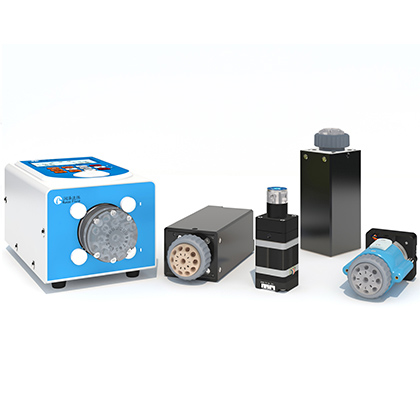
Automated fluid dispensing requires more than simply moving liquid from one point to another. A dispensing system may need to deliver a defined volume repeatedly, respond to start and stop commands, accommodate different production cycles, and maintain consistent performance as operating conditions change. For these applications, a stepper peristaltic pump offers a practical combination of controllable flow, repeatable operation, and fluid isolation.
The underlying peristaltic pump working principle is relatively simple. A rotating mechanism compresses flexible tubing at successive points, creating a moving occlusion that draws fluid through the tube and pushes it toward the outlet. Because the fluid remains inside the tubing rather than contacting the pump's internal drive components, the pump can be useful for applications where contamination control, easy maintenance, or fluid isolation matters.
Adding a stepper motor gives this basic pumping principle a high degree of motion control. The motor can be commanded to rotate in controlled increments, allowing the pump to respond precisely to programmed speed, direction, acceleration, and operating cycles. This makes a stepper peristaltic pump particularly relevant to automated dispensing equipment, laboratory automation, filling systems, analytical instruments, and other applications where the pump needs to work as part of a larger control system.
In an automated dispensing system, pump speed directly influences how quickly fluid moves through the tubing. The more consistently that speed can be controlled, the easier it becomes to establish a predictable relationship between the pump command and the resulting fluid delivery.
A stepper motor is well suited to this type of control because its rotation can be divided into controlled increments. Depending on the motor, driver, transmission, and control strategy, the system can command relatively small changes in rotational movement. This provides the automation controller with a practical way to adjust dispensing speed according to the requirements of the process.
The peristaltic pump working principle also contributes to predictable fluid movement because the rotating mechanism repeatedly compresses the tubing. Each rotation produces a corresponding sequence of tube occlusions and fluid displacement. When tubing, pump speed, and operating conditions remain consistent, the relationship between rotational movement and flow can be characterized during system development.
For automated equipment, this means the pump can be incorporated into a programmed dispensing sequence rather than relying on manual adjustment. The controller can specify when the pump starts, how quickly it runs, when it stops, and whether it needs to reverse or adjust its speed.
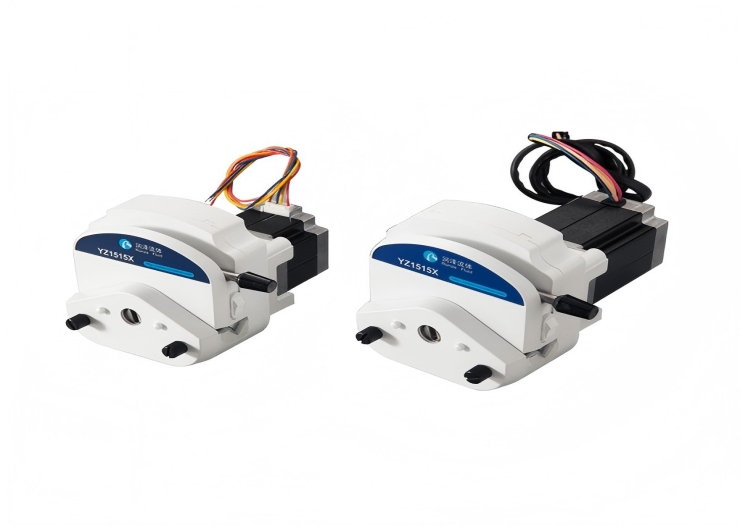
Accuracy and repeatability are related but different considerations. Accuracy describes how closely the delivered quantity matches the intended target, while repeatability describes how consistently the system produces the same result over repeated cycles.
For automated dispensing, repeatability is often critical because a machine may perform the same operation many times. Even if the average dispensing volume appears correct, large variations from one cycle to another can create quality problems downstream.
A stepper peristaltic pump can support repeatable operation by combining controlled motor movement with the predictable mechanical action of the peristaltic mechanism. However, the pump is not the only factor determining dispensing repeatability. Tubing dimensions, elasticity, wear, fluid viscosity, inlet conditions, outlet resistance, and the time between dispensing cycles can all influence the final result.
The tubing is especially important because it is both the fluid path and an active component of the pumping mechanism. If its elasticity changes significantly over time, the amount of fluid displaced by each compression cycle may also change. Automated systems therefore need to consider tubing life and replacement intervals as part of the overall maintenance strategy.
| Performance Factor | Why It Matters in Automation | What to Monitor |
|---|---|---|
| Speed control | Determines how consistently fluid is moved | Motor command, operating speed, acceleration |
| Repeatability | Supports consistent results across dispensing cycles | Delivered volume or mass over repeated cycles |
| Start-stop response | Influences when dispensing begins and ends | Acceleration, deceleration, residual flow |
| Tubing condition | Affects displacement and long-term consistency | Wear, elasticity, deformation, leakage |
| Fluid characteristics | Can change the actual delivery behavior | Viscosity, temperature, particulates, air content |
By treating these factors as part of one dispensing system, engineers can obtain a much clearer picture of actual performance than by looking at the pump's nominal flow specification alone.
Automated dispensing rarely involves continuous pumping at a fixed speed. Many machines need the pump to start, deliver a controlled quantity, stop, wait, and then repeat the sequence. The quality of these transitions can have a direct effect on dispensing consistency.
A stepper peristaltic pump can be integrated into such sequences because the motor can be controlled according to commands from a programmable controller, motion controller, PLC, or other automation hardware. The pump can be started at a defined speed, ramped toward its operating condition, and stopped according to the requirements of the process.
Start-stop behavior also needs to be considered in relation to fluid inertia and tubing elasticity. When the motor stops, the fluid does not necessarily behave as though an ideal mechanical valve has instantly closed. Flexible tubing can recover from compression, and pressure within the fluid path can cause a small amount of continued movement.
For applications that require highly controlled dispensing volumes, the automation program may therefore need to account for the pump's actual stopping behavior. Calibration can help determine whether a small timing or speed adjustment is needed to compensate for the characteristics of the particular tubing and fluid system.
This is another area where understanding the peristaltic pump working principle is useful. The pump does not simply switch fluid flow on and off electronically. Its mechanical interaction with the tubing determines how the fluid responds during every stage of the dispensing cycle.
Because the tubing is compressed repeatedly during operation, tubing selection is central to the performance of a peristaltic pump. The material needs to withstand repeated compression while maintaining appropriate elasticity and dimensional stability for the intended application.
Tube internal diameter influences the amount of fluid moved through each pumping cycle, while wall thickness and material properties affect how effectively the pump can occlude the tube. If the tubing does not recover consistently after compression, flow characteristics may change over time.
Fluid compatibility is equally important. A tubing material that is suitable for one liquid may not be appropriate for another, particularly when the fluid contains aggressive chemicals, solvents, oils, biological components, or abrasive particles. Temperature can also affect tubing properties and should be considered alongside chemical exposure.
For automated dispensing, tubing life can be just as important as initial flow performance. A tube that delivers the desired volume when new but changes significantly after repeated cycles may increase recalibration requirements and maintenance costs.
Runze Fluid's fluid-handling solutions can be considered as part of this broader system approach. When reviewing the available Runze Fluid pump and fluid-handling products, users can evaluate the pump together with the application requirements rather than treating the pump as an isolated component.
Automated equipment often needs to handle more than one dispensing condition. A machine may use a relatively high flow rate during initial filling and then switch to a slower rate for final dosing. Other systems may use different dispensing volumes for different products or production recipes.
A stepper peristaltic pump provides flexibility because motor speed can be adjusted according to the programmed dispensing requirement. Rather than relying on a single fixed operating point, the controller can use different speed commands for different stages of a process.
However, changing the commanded speed does not automatically guarantee proportional changes in delivered flow. The actual result depends on tubing characteristics, fluid viscosity, system pressure, pump geometry, and other operating conditions. For this reason, different flow rates should be validated rather than assuming that one calibration point applies perfectly across the entire operating range.
The same principle applies to dispensing volume. A longer operating time at a controlled speed can produce a larger quantity, while a shorter cycle can produce a smaller quantity. In applications where precise volume is important, the system should be calibrated under representative conditions, including the actual tubing and fluid that will be used in production.
This approach makes the peristaltic pump working principle particularly useful for automation: the pump provides a controllable mechanical means of moving fluid, while the control system determines when and how that movement occurs.
Integrating a pump into an automated machine involves more than selecting a suitable flow range. The pump must communicate effectively with the control architecture and physically fit the available space, tubing route, and connection arrangement.
The required control interface should be established at the beginning of the design process. Depending on the pump configuration, the automation system may need to control parameters such as speed, direction, start and stop commands, or operating sequences. The controller and pump driver should therefore be compatible with the intended control architecture.
Mechanical integration is also important. Tubing routing should avoid unnecessary bends, excessive tension, or sharp contact points that could affect service life. The pump should be mounted securely enough to prevent unwanted movement or vibration during operation.
The fluid characteristics need to be considered at the same time. Viscosity, temperature, particulates, sensitivity to shear, and the potential presence of air can all affect dispensing performance. A system that works well with one fluid may require different calibration or tubing for another.
Finally, maintenance should be considered before the system enters production. Since the tubing is repeatedly compressed, it is a consumable component in many peristaltic pump applications. Establishing a practical inspection and replacement strategy can help maintain consistent performance over the life of the equipment.
When the application involves several variables, discussing the complete operating conditions with the manufacturer can be more useful than selecting a pump solely from a catalog flow range. For an application involving specific dispensing volumes, fluid characteristics, tubing requirements, and automation interfaces, contact Runze Fluid to discuss the operating conditions and pump configuration with the application in mind.
A stepper peristaltic pump is well suited to automated fluid dispensing because it combines controllable motor movement with the simple and inherently isolated peristaltic pump working principle. The stepper motor provides a practical way to control pump speed and dispensing sequences, while the peristaltic mechanism moves fluid through the tubing without requiring the liquid to contact the pump's main mechanical components.
Reliable automated dispensing still depends on the complete system. Speed control, repeatability, start-stop behavior, tubing properties, fluid characteristics, operating conditions, and controller integration all contribute to the final result. In particular, tubing should be treated as an important part of the pump rather than simply as an accessory.
When these factors are matched carefully, a stepper peristaltic pump can provide the controllable and repeatable fluid movement required for laboratory automation, dosing equipment, filling systems, analytical instruments, and other automated fluid-handling applications.
A stepper peristaltic pump allows controlled motor movement and can be integrated into programmed start-stop and speed-control sequences, making it suitable for automated dispensing applications.
A stepper motor can provide controlled rotational movement, allowing the automation system to adjust pump speed and operating sequences according to the dispensing requirements.
The tubing is repeatedly compressed during operation. Its internal diameter, wall thickness, elasticity, material, and condition influence how much fluid is displaced and how consistently the pump operates.
Yes. Different volumes can generally be achieved by changing the pump's operating speed, running time, or both. Each required operating condition should be validated for the actual fluid and tubing configuration.
The fluid remains inside the tubing and does not normally contact the pump's main drive mechanism. This can simplify fluid isolation and reduce contamination concerns associated with direct-contact pumping mechanisms.
Consider the required flow range, dispensing volume, tubing, fluid properties, pressure conditions, control interface, mechanical installation, start-stop behavior, calibration, and tubing replacement requirements.


 English
 日本語
日本語 한국어
한국어 français
 Deutsch
 Español
 italiano
 русский
 português
 Türkçe
 Nederland