
86-025-5119 7362

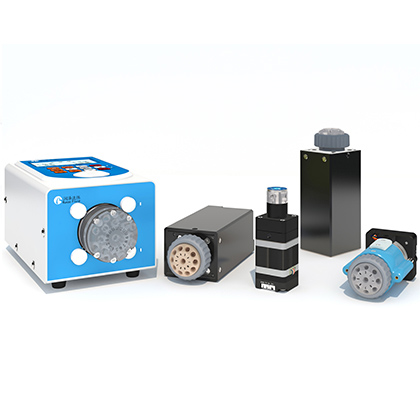
SY-03B syringe pump selection should begin with the required dose, liquid, pressure, flow path, communication interface, and available installation space. The RUNZE catalog publishes a useful family-level screening envelope, while a sales application record for an SY03BM configuration shows the practical questions that equipment builders ask when comparing precision dispensing with peristaltic pumping. These sources support a structured selection process, but they do not establish performance for every liquid, valve, syringe, partial stroke, or custom model. The final configuration should therefore be confirmed against the current model code, drawing, protocol manual, and an application test.
Use the SY-03B family as a candidate when the equipment needs a 60 mm syringe stroke, a selectable syringe from 50 microliters through 10 milliliters with 25 and 50 milliliter options listed as custom, an integrated distribution or switching valve, and RS232, RS485, or CAN control. The catalog states volume accuracy error of no more than 1 percent of rated stroke and repeatability error of 0.3 to 0.5 percent of rated stroke. Treat those values as catalog conditions, not as a guarantee for a small partial dose. Select the syringe size so the normal dispense uses a meaningful part of the stroke, then confirm valve-port count, bore, wetted materials, pressure demand, refill behavior, bubbles, dripping, timing, and communication on the complete fluid path.
The catalog groups the SY-03B with several valve-head and syringe choices. The values below are published for the SY-03B family. A suffix such as SY03BM may identify a configuration or variant that is not fully defined in the source set. Do not transfer every family value to an ordered model without confirming the current specification.
Selection item | Published family value | Engineering use |
Rated stroke | 60 mm | Sets the mechanical travel available for aspiration and dispense |
Syringe options | 50 uL, 100 uL, 250 uL, 500 uL, 1 mL, 1.25 mL, 2.5 mL, 5 mL, 10 mL; 25 mL and 50 mL custom | Choose around the working dose and refill strategy |
Volume accuracy | Error no more than 1 percent of rated stroke | Do not assume the same percentage for a very small partial stroke |
Repeatability | 0.3 to 0.5 percent of rated stroke | Validate with the selected liquid, syringe, valve, and cycle |
Linear speed | 0.01 to 60 mm per second | Screen cycle time and refill demand |
Control resolution | 0.01 mm per step | Relate commanded travel to theoretical displacement, then calibrate delivered volume |
Interfaces | RS232, RS485, and CAN | Confirm protocol, baud rate, addressing, wiring, and command timing |
Power | DC 24 V at 3 A | Size the supply and wiring with equipment-level margin |
Define the dispense window before selecting a syringe. Record the minimum, normal, and maximum dose; allowable error and repeatability; cycle time; duty cycle; source and destination pressure; refill time; and whether the process can pause for aspiration. A bottle-cap assembly or point-dispensing machine may value dose consistency and programmed cycling, while an analyzer may also require low carryover, multiple reagents, and controlled wash sequences. These are different fluidic problems even when both use the same pump family.
A larger syringe can reduce refill frequency, but it also produces more volume for a given piston movement. If the normal dose uses only a very small fraction of the 60 mm stroke, command resolution, backlash, valve cavity volume, tubing compliance, droplet formation, and trapped gas can dominate the delivered result. A smaller syringe may give more useful piston travel per dose, although it may require more refill cycles. The source documents do not publish minimum validated dose, partial-stroke accuracy, or a full accuracy map for each syringe size. Data not available in source documents. Determine those values through testing rather than dividing the rated-stroke specification into an assumed universal percentage.
The catalog lists MY-3, MT-3, MC-4, MCC-4, and T-03 valve heads, plus T-04, T-06, T-08, T-09, T-10, T-12, T-14, and T-16 distribution options. The port count alone does not define suitability. Map every source, destination, wash liquid, waste line, air position, calibration standard, and service route. Then confirm the common port, switching logic, permitted connection sequence, valve-bore diameter, internal cavity, and whether unused positions create a cleaning or contamination risk.
Published bore choices vary by valve group. The MY-3, MT-3, MC-4, MCC-4, and T-03 group is listed with 1.2 or 2.0 mm bores. T-04 through T-12 are listed at 1.0 mm, and T-14 and T-16 at 1.2 mm. A larger bore can reduce restriction but increases internal volume. A smaller bore can reduce contained volume but raises pressure loss, especially during fast refill or with viscous liquid. The catalog does not provide pressure-drop curves, cavity volumes, or maximum viscosity by valve. Data not available in source documents. Calculate the tubing volume, measure the actual dispense delay, and test the worst refill condition.
The catalog describes alumina ceramic in the valve component and high-borosilicate glass with PTFE in the syringe. It also lists PPS as the default shell for several distribution valves, with selected custom shell materials including PEEK, PCTFE, stainless steel, or full ceramic. T-14 and T-16 are shown with a default SUS316 shell and no custom shell material. These descriptions are not a chemical-compatibility certificate. Confirm every wetted surface, seal, adhesive, tube, connector, and cleaning chemical for the exact model.
Architecture | Useful when | Engineering checks |
SY-03B syringe pump with valve | Programmed aspiration and precise discrete dispensing with multiple routes | Partial-stroke validation, refill pause, bubbles, valve cavity, pressure, and cleaning |
Peristaltic pump | The liquid should remain inside replaceable tubing and continuous transfer is more important than syringe positioning | Tube wear, calibration drift, pulsation, occlusion, suction lift, and replacement interval |
Two-pump or accumulator system | Outlet flow must continue while one chamber refills | Synchronization, crossover ripple, extra valves, control logic, and fault recovery |
This comparison describes system architecture, not a performance ranking. The sales record correctly frames cost and precision as a tradeoff to investigate, but its application-specific statements do not replace a controlled comparison. Use the same liquid, tubing, outlet restriction, target dose, temperature, cycle count, and measurement method when comparing alternatives. Otherwise, an apparent pump difference may actually come from calibration, tube condition, nozzle behavior, or test setup.
The SY-03B catalog lists 6000 control steps and 48000 steps in microstep mode, a linear speed range of 0.01 to 60 mm per second, and a rated-stroke travel time from 1 to 6000 seconds. Those numbers help screen motion and cycle time, but delivered liquid timing also includes valve movement, communication, acceleration, aspiration, settling, dispense, and any anti-drip action. The catalog lists adjacent-port switching time of no more than 280 ms. System software should wait for confirmed states instead of assuming that a command transmission immediately means fluid motion is complete.
RS232 and RS485 baud rates are listed as 9600, 19200, 38400, 57600, and 115200 bps. CAN rates are listed as 100 kbps, 200 kbps, 500 kbps, and 1 Mbps, and the catalog says up to 15 independent addresses can be provided. Confirm the exact protocol and addressing rules for the purchased unit. A model that supports a physical interface may still require a particular command set or firmware option. Define command timeout, retry behavior, inter-command delay, error handling, power-loss recovery, and safe valve position before production release.
The catalog lists an SY-03B envelope of 65 by 253.3 by 151 mm and a mass of 2.2 kg without the syringe. It specifies 5 to 55 degrees C and below 80 percent relative humidity without condensation. The installation drawing also shows front, back, side, top, and bottom views with mounting features. Reserve additional space for the syringe, fittings, tube bend radius, connectors, wiring, valve service, and syringe replacement. Do not design the enclosure from the catalog bounding box alone.
The source set does not publish an ingress-protection rating, vibration limit, approved mounting orientations, noise level, or validated exposure to splashes. Data not available in source documents. The SY03BM sales record specifically warns against exposing an unprotected drive board to dispensed liquid, which is a sound equipment-level concern. Use a suitable enclosure or drip management strategy, and confirm heat, grounding, electrical safety, and service access in the final machine.
· Confirm the exact model code, syringe, valve head, bore, material, connector, protocol, and mounting drawing.
· Measure minimum, normal, and maximum doses across the planned stroke range using a documented gravimetric or volumetric method.
· Test aspiration completeness at the lowest source level, highest viscosity, coldest temperature, longest inlet tube, and fastest planned refill.
· Measure dripping, stringing, bubbles, residual volume, carryover, wash demand, and nozzle behavior with the actual liquid path.
· Run repeated cycles at the production duty cycle and track dose drift, valve behavior, motor temperature, communication errors, and recovery after power interruption.
· Challenge blocked outlet, empty source, trapped gas, communication timeout, valve-position error, and interrupted motion with a defined safe response.
The catalog states volume accuracy error of no more than 1 percent of rated stroke and repeatability error of 0.3 to 0.5 percent of rated stroke. These are rated-stroke statements. Minimum-dose and partial-stroke performance are data not available in source documents.
The catalog lists 50 uL, 100 uL, 250 uL, 500 uL, 1 mL, 1.25 mL, 2.5 mL, 5 mL, and 10 mL, with 25 mL and 50 mL identified as custom. Confirm availability and the exact syringe construction for the ordered model.
No universal viscosity limit is published in the reviewed sources. Viscosity affects refill, pressure loss, bubbles, settling, and nozzle behavior. Test the actual liquid at the worst temperature and inlet condition.
The catalog lists three-port and four-port options and distribution valves through sixteen positions. The usable route count depends on the exact valve topology and the role of the common port, so confirm the port map rather than selecting only by the largest number.
A single syringe normally alternates aspiration and dispense, so the outlet can pause during refill. If uninterrupted flow is required, evaluate a two-pump or accumulator architecture and measure crossover pulsation.
Choose RS232 for a direct short point-to-point connection, RS485 when the equipment design needs a differential serial bus, or CAN when the controller architecture uses CAN. The final choice must also match the supported protocol, electrical interface, address plan, and software timing.
A defensible SY-03B syringe pump selection connects the required dose and cycle to a specific syringe, valve, bore, material, interface, and installation. The published 60 mm stroke, syringe range, valve choices, communication options, and rated-stroke accuracy provide a useful starting envelope. They do not remove the need to validate partial doses, refill, bubbles, pressure, carryover, timing, and endurance on the assembled machine. Confirm the exact SY03BM or other variant against current controlled documents before ordering, then release it only after the real liquid and production cycle pass a documented test plan.


 English
 日本語
 한국어
 français
 Deutsch
 Español
 italiano
 русский
 português
 Türkçe
 Nederland