
86-025-5119 7362

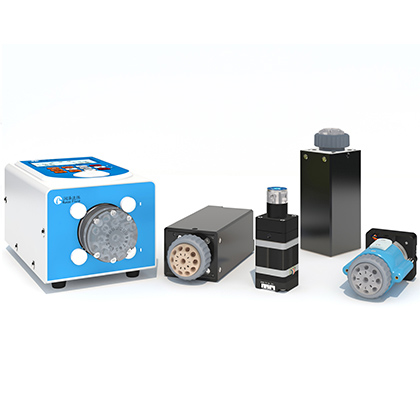
In automated sample preparation systems, environmental analyzers, laboratory instruments, medical analysis equipment, and chromatographic analyzers, the fluidic routing component that connects one pump or analytical flow path to multiple sample channels, reagent bottles, calibration standards, wash solutions, and waste lines is not a passive connector — it is a precision fluid control component whose dead volume, rotor and stator material, sealing geometry, port configuration, and communication interface collectively determine whether the analytical results the instrument produces are accurate, reproducible, and free from cross-contamination. Even a few microliters of residual liquid trapped in valve grooves, fitting cavities, or unused channel dead volume can mix with the next sample, create carryover that distorts concentration measurements, and generate false analytical results that undermine the instrument's credibility and the laboratory's data quality.
This is why a high-precision safety selector valve — specifically a compact stream selector valve or small-bore rotary valve designed for automated sample preparation fluidics — has become the preferred fluid routing solution for instrument engineers who need to switch between multiple channels cleanly, consistently, and reliably in limited instrument space. Compared with a bulky solenoid valve manifold that introduces multiple fitting transitions, inconsistent flow paths, and complex wiring, a rotary selector valve with a centralized common port, optimized dead volume geometry, chemically compatible wetted materials, and digital communication control provides a more compact, more consistent, and more contamination-resistant fluid routing architecture. Runze's SV-07 offers 6, 8, 10, 12, and 16-port options, PCTFE wetted material, patented sapphire rotor and stator technology, RS232, RS485, and CAN communication, and compact dimensions for limited instrument space — providing the specification depth and material quality that demanding automated analytical applications require.
This guide covers the complete picture for instrument engineers, fluidic system designers, and procurement managers: why dead volume and cross-contamination distort sample results, what a stream selector valve is and how it functions in automated sample preparation, how rotary selector valve design reduces fluidic complexity and contamination risk, how to evaluate selector valve components for chemical compatibility and cycle life, and what maintenance practices protect valve performance and analytical accuracy through the instrument's service life.
The commercial and technical case for investing in a properly specified safety selector valve starts with a clear understanding of the specific mechanisms by which dead volume and cross-contamination create analytical errors in automated sample preparation systems — and why these problems are particularly difficult to detect because they manifest as gradual result drift rather than obvious instrument failure.
Residual liquid in valve grooves and fitting cavities is the most common source of carryover in automated sample preparation fluidics — and the most difficult to eliminate because it is determined by the internal geometry of the valve and fittings rather than by the flushing protocol. When a selector valve switches from one sample channel to the next, any liquid remaining in the valve's internal flow path, port grooves, or fitting dead volume mixes with the incoming sample — creating a diluted or contaminated sample that produces an analytical result reflecting a mixture of the previous and current samples rather than the current sample alone.
The severity of the carryover depends on the ratio of the dead volume to the sample volume — which means that carryover is most damaging in low-volume analytical systems where the sample volume is small relative to the valve's internal dead volume. In environmental analyzers measuring trace contaminants at parts-per-billion concentrations, a carryover of even 0.1% from a high-concentration previous sample can create a false positive result that triggers unnecessary regulatory action. In medical analysis equipment where sample integrity is a patient safety requirement, carryover can create diagnostic errors with direct clinical consequences.
Inconsistent flow paths between channels is the second dead volume problem that affects analytical accuracy in solenoid valve manifold designs — where each channel passes through a different combination of valve bodies, fittings, and tubing connections that create different dead volumes, different flow resistances, and different carryover characteristics for each channel. This channel-to-channel inconsistency creates systematic differences in the analytical results from different channels that cannot be corrected by calibration — because the calibration standard and the sample pass through different flow paths with different dead volume characteristics.
For instruments operating in regulated testing environments — environmental monitoring, clinical diagnostics, pharmaceutical quality control — cross-contamination is not simply a performance problem. It is a validation failure that requires investigation, corrective action, and revalidation before the instrument can return to service. The cost of a single cross-contamination-related validation failure — in investigation time, revalidation effort, and lost instrument availability — can exceed the cost of the entire fluidic system that caused the problem.
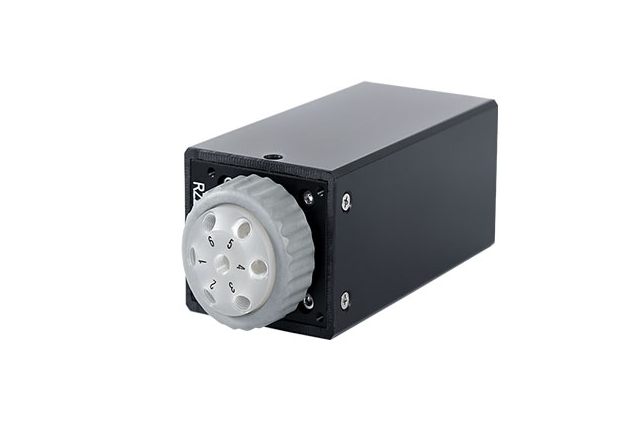
Understanding what a safety selector valve is — and how its port configuration, rotor and stator design, wetted material specification, and communication interface work together as a precision fluid routing component — is essential for engineers evaluating selector valve specifications for automated sample preparation instrument integration.
A safety selector valve is a multiport fluidic component that connects one common port to one selected channel at a time — allowing one pump or analytical flow path to access multiple reagents, samples, calibration standards, wash solutions, or waste lines through a single compact valve assembly. Runze's SV-07 selector valve uses a center public port, and the valve switches to a specific port through programming control, supporting 6, 8, 10, 12, and 16-port configurations to meet different fluidic application requirements.
A stream selector valve is not simply a connector — it is a precision routing component that determines how cleanly, consistently, and safely fluids move through an automated sample preparation system. The valve's internal geometry, rotor and stator material, sealing precision, and dead volume characteristics determine the carryover performance that directly affects analytical accuracy.
| Parameter | SV-07 Specification |
|---|---|
| Port options | 6, 8, 10, 12, 16 port |
| Orifice | 1.2 mm for 6, 8, 10-port; 1.0 mm for 12, 16-port |
| Wetted material | PCTFE, sapphire rotor and stator |
| Pressure rating | 0 to 1 MPa air, 0 to 1.6 MPa water |
| Liquid temperature | 0 to 150°C |
| Connection | 1/4-28UNF |
| Communication | RS232, RS485, CAN |
| Power supply | DC24V, 3A |
| Application fields | Environmental analysis, laboratory analyzers, medical analysis equipment, chromatographic analyzers |
The technical mechanism by which a rotary selector valve's centralized common port, optimized dead volume geometry, and precision rotor and stator design reduce cross-contamination risk and fluidic complexity compared with solenoid valve manifold alternatives — and why these design advantages translate into better analytical accuracy and lower instrument maintenance workload — is the core engineering knowledge that instrument designers need to specify the right fluid routing architecture.
A rotary selector valve uses a precisely machined rotor and stator. The common port remains fixed at the center, while the rotor rotates to align the internal flow path with the selected peripheral port. The controller commands the valve to move to the required position, allowing one pump to access multiple channels through a single centralized flow path that has consistent geometry regardless of which channel is selected.
The dead volume advantage of a rotary selector valve over a solenoid valve manifold comes from this centralized architecture — because all channels share the same common port and the same internal flow path geometry, the dead volume characteristics are consistent across all channels, and the flush volume required to clear the previous sample is predictable and consistent. In a solenoid valve manifold, each channel has its own valve body, fittings, and tubing connections — creating channel-to-channel dead volume differences that make carryover performance inconsistent and difficult to characterize.
| Performance Factor | Rotary Selector Valve | Solenoid Valve Manifold | Selection Guidance |
|---|---|---|---|
| Space requirement | Compact single-body design | Larger manifold footprint | Rotary valve for space-limited instruments |
| Flow path consistency | Centralized and repeatable across all channels | Multiple valve-to-valve transitions per channel | Rotary valve for consistent carryover performance |
| Dead volume control | Optimized through rotor and stator geometry | More fittings and branches increase residual volume | Rotary valve for low-carryover applications |
| Wiring complexity | One motorized valve module | Multiple solenoids and cables | Rotary valve for simplified integration |
| Maintenance | One main valve assembly | Multiple individual valves to inspect | Rotary valve for lower maintenance workload |
| Best application | Multi-channel sample and reagent selection | Simple on/off switching | Match to application architecture |
In practice, "zero dead volume" means minimizing trapped residual volume as much as possible through optimized valve geometry, short tubing runs, precise fittings, and correct flushing procedures — rather than achieving a literally zero internal volume, which is physically impossible. Buyers evaluating zero dead volume selector valve claims should request port-to-port dead volume data, internal flow path design documentation, rotor and stator sealing method description, tubing and fitting recommendations, flush volume recommendations, and carryover test method and results. Runze publishes SV-07 dead volume figures by configuration, including port-to-port and internal dead volume values for different port counts — providing the objective data that engineers need to evaluate carryover performance for their specific application.
The systematic evaluation of safety selector valve components — rotor and stator material, wetted path chemistry, port configuration, orifice size, and communication protocol — against the requirements of the specific automated sample preparation application is the technical procurement knowledge that separates a well-specified valve integration from a costly field reliability problem.
The rotor and stator interface is the most mechanically and chemically demanding component in a rotary selector valve — because it must maintain precise sealing geometry through millions of rotation cycles while resisting chemical attack from the full range of media that the valve will contact. Poor material selection at the rotor and stator interface creates wear particles that contaminate samples, leakage paths that create cross-contamination, chemical swelling that distorts sealing geometry, and sample adsorption that creates carryover from previous samples.
Runze states that the SV-07 uses PCTFE wetted material and a sapphire rotor and stator — a non-metal design that provides anti-corrosion performance, high-temperature resistance up to 150°C, and wear resistance suitable for special media and demanding analysis applications. Sapphire's extreme hardness and chemical inertness make it one of the most demanding rotor and stator materials available for analytical fluidics — providing the wear resistance and chemical compatibility that high-cycle automated sample preparation applications require.
A 6-port or 8-port selector valve with 1.2 mm orifice is suitable for standard multi-channel sample selection, reagent switching, and calibration standard routing in laboratory analyzers and environmental monitoring instruments where the number of channels is moderate and the orifice size is appropriate for the flow rates and tubing dimensions of the system.
A 12-port selector valve with 1.0 mm orifice is suitable for complex analytical systems that require simultaneous access to multiple samples, multiple reagents, multiple calibration standards, wash solutions, and waste lines — providing the channel count that eliminates the need for multiple valve assemblies in complex automated sample preparation workflows.
A 16-port selector valve with 1.0 mm orifice is suitable for high-throughput automated analytical platforms where the maximum number of channels must be accommodated in a single compact valve assembly — providing the port count that supports the most complex multi-channel fluidic architectures in the smallest possible instrument footprint.
The SV-07 supports RS232 and RS485 baud rates of 9600, 19200, 38400, 57600, and 115200 bps, and CAN baud rates of 100 Kbps, 200 Kbps, 500 Kbps, and 1 Mbps — covering the full range of instrument and automation communication requirements from simple bench instruments to complex distributed analytical platforms. Address and parameter settings are managed through communication, allowing multiple SV-07 valves to be addressed independently on a shared communication bus for multi-valve instrument architectures.
Procuring the right safety selector valve for a specific automated sample preparation application requires systematic pre-order confirmation of port configuration, chemical compatibility, dead volume requirements, communication protocol, and maintenance expectations — and a maintenance program that protects valve performance and analytical accuracy through the instrument's service life.
Before requesting a quotation for a stream selector valve, prepare and confirm the following:
Confirm the required port count — 6, 8, 10, 12, or 16 — based on the number of channels required for the specific automated sample preparation workflow
Confirm the valve function — sample selection, reagent selection, calibration standard switching, wash liquid selection, or waste routing — and verify that the selected port configuration supports the complete fluid path architecture
Confirm the liquid media list and concentration — and request a chemical compatibility assessment for all wetted materials including the PCTFE valve head, sapphire rotor and stator, and 1/4-28UNF fittings
Confirm the dead volume target and carryover limit — and request port-to-port dead volume data and carryover test results for the selected port configuration
Confirm the maximum operating pressure and temperature — and verify that the selected valve's pressure rating of 0 to 1.6 MPa water and temperature rating of 0 to 150°C provide adequate margin for the application
Confirm the orifice size requirement — 1.2 mm for 6, 8, and 10-port configurations, or 1.0 mm for 12 and 16-port configurations — based on the flow rates and tubing dimensions of the system
Confirm the communication protocol requirement — RS232, RS485, or CAN — and verify that the manufacturer can provide complete command documentation for instrument control software integration
Confirm the mounting space and orientation — and verify that the selected valve's compact dimensions fit within the available instrument space with adequate clearance for tubing, wiring, and maintenance access
Flush the valve after samples with high salt, protein, particles, or reactive chemicals — residual chemical concentration between operating cycles accelerates rotor and stator wear and creates carryover risk
Use filtered reagents when possible — particulate contamination is a primary cause of premature rotor and stator wear in precision rotary selector valves
Verify valve position and reset logic during system startup — confirming that the valve homes correctly to the reference position ensures that channel selection is accurate from the first cycle
Validate carryover after installation and after maintenance — objective carryover measurement confirms that the valve is performing within the specification required for the analytical application
Do not exceed rated pressure or temperature — operating beyond the valve's rated conditions accelerates wear and may cause leakage or rotor and stator damage
Run cleaning protocols before long-term shutdown — removing reactive or crystallizing media from the valve before shutdown prevents chemical attack and crystallization damage during storage
Record cycle count, fluid exposure, and maintenance history — a complete maintenance log supports condition-based service decisions and provides the traceability that regulated testing environments require
Runze notes that the SV-07 has a replaceable stator, while the sealed rotor is not replaceable — making preventive cleaning and correct fluid compatibility the most important maintenance practices for long-term valve reliability.
In automated sample preparation, cross-contamination is not simply a fluidic design problem — it is a data reliability problem that affects every analytical result the instrument produces and every decision that is made based on those results. A high-precision safety selector valve with optimized dead volume geometry, sapphire rotor and stator material, PCTFE chemical compatibility, compact multiport configuration, and digital communication control is the fluidic routing solution that addresses this problem at its source — providing the channel switching cleanliness, flow path consistency, and chemical resistance that demanding automated analytical applications require.
Runze provides selector valves, multi-position valves, syringe pumps, peristaltic pumps, high-pressure solenoid valves, fluidic fittings, tubing, communication accessories, and OEM fluidic solutions for environmental analysis, laboratory instruments, medical equipment, petrochemical engineering, food and beverage testing, and bio-pharmaceutical applications.
Contact Runze today to discuss your port count, flow path diagram, dead volume target, chemical media, pressure range, control protocol, mounting space, and OEM customization needs for the SV-07 stream selector valve. Runze can help evaluate the right safety selector valve specification for your automated sample preparation application and provide the technical documentation and supply reliability that demanding analytical instrument integration requires.
Q1: What is a safety selector valve and how does it work in automated sample preparation?
A safety selector valve is a multiport fluidic component that connects one common port to one selected channel at a time — allowing one pump or analytical flow path to switch between multiple samples, reagents, calibration standards, wash solutions, or waste lines through a single compact valve assembly. In automated sample preparation, it replaces multiple individual valves with a single centralized routing component that provides consistent flow path geometry, minimized dead volume, and programmable channel selection through digital communication control.
Q2: What is a stream selector valve used for in analytical instruments?
A stream selector valve is used to select one fluid stream from multiple channels in automated analytical instruments — switching between sample bottles, reagent containers, calibration standards, wash solutions, and waste lines under instrument control. It is commonly used in environmental analyzers, laboratory analyzers, medical analysis equipment, and chromatographic systems where multiple fluid sources must be accessed through a single analytical flow path.
Q3: What causes cross-contamination in automated sample preparation fluidics?
Cross-contamination is caused by residual liquid trapped in dead volume — valve grooves, fitting cavities, tubing transitions, and unused channel connections — that mixes with the next sample when the valve switches channels. The severity depends on the ratio of dead volume to sample volume, making dead volume minimization the most important design parameter for cross-contamination control in low-volume analytical systems.
Q4: Is a rotary selector valve better than a solenoid valve manifold for multi-channel sample selection?
For multi-channel sample or reagent selection in automated sample preparation, a rotary selector valve provides significant advantages over a solenoid valve manifold: more compact single-body design, more consistent centralized flow path geometry across all channels, easier dead volume optimization through rotor and stator geometry, simpler wiring with one motorized valve module, and lower maintenance workload with one main valve assembly to inspect. A solenoid valve manifold may be more appropriate for simple on/off switching applications where the number of channels is small and continuous flow is not required.
Q5: What does "zero dead volume selector valve" mean in practice?
In practice, zero dead volume means the valve is designed to minimize trapped residual volume as much as possible through optimized rotor and stator geometry, short internal flow paths, precise fitting connections, and correct flushing procedures — rather than achieving a literally zero internal volume. Buyers should request port-to-port dead volume data, internal flow path design documentation, and carryover test results rather than relying on the phrase alone to evaluate actual carryover performance.
Q6: What are the key specifications of the Runze SV-07 safety selector valve?
The Runze SV-07 supports 6, 8, 10, 12, and 16-port configurations, PCTFE wetted material, sapphire rotor and stator, 0 to 1 MPa air pressure rating, 0 to 1.6 MPa water pressure rating, 0 to 150°C liquid temperature, 1.2 mm orifice for 6, 8, and 10-port configurations, 1.0 mm orifice for 12 and 16-port configurations, 1/4-28UNF connection, and RS232, RS485, and CAN communication — providing the specification range that covers standard laboratory analyzers through demanding chromatographic and environmental analysis applications.
Q7: Why choose Runze SV-07 for automated sample preparation fluidics?
The Runze SV-07 is designed for compact multiport flow selection with chemical compatibility, wear resistance, and automation control capability. Its sapphire rotor and stator design provides the hardness and chemical inertness required for high-cycle analytical applications, its PCTFE wetted material provides broad chemical compatibility including resistance to solvents, acids, and biological samples, its 6 to 16-port configuration range covers the full spectrum of multi-channel analytical architectures, and its RS232, RS485, and CAN communication support enables clean integration with the full range of instrument control architectures.


 English
 日本語
日本語 한국어
한국어 français
 Deutsch
 Español
 italiano
 русский
 português
 Türkçe
 Nederland