
86-025-5119 7362

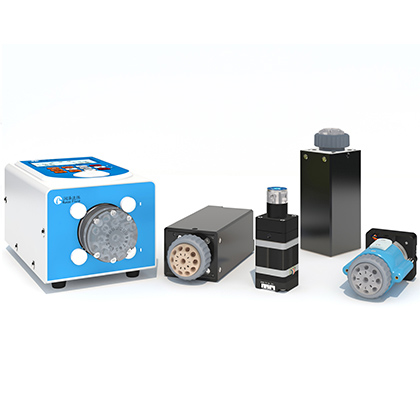
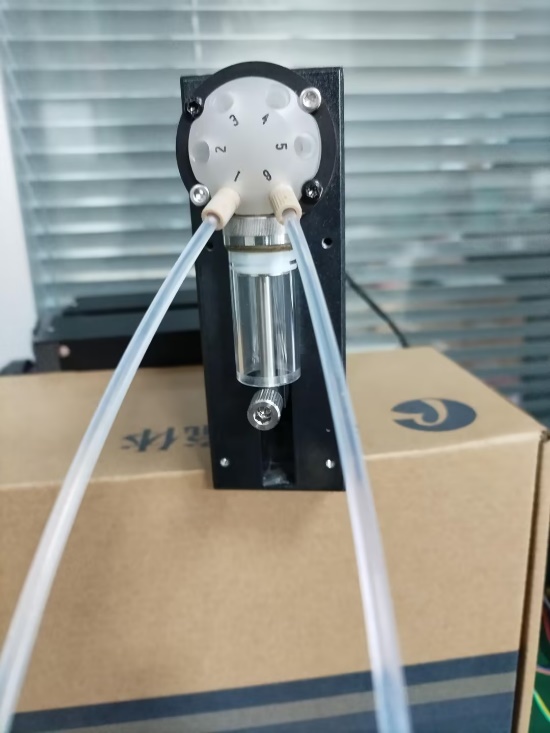
SY-01B syringe pump test data help engineers understand how the pump behaves with different liquids and operating speeds. The source document includes two practical tests. The first evaluates whether an SY-01B can pump cooking oil at 60 mL/min. The second checks whether low-speed water operation creates vacuum inside the syringe or residual dripping after the pump stops.
The cooking oil test used model ZSB-SY01B-30-M06-3 with a 5 mL syringe and FEP tubing. The vacuum and dripping test used model ZSB-SY01B-30-M01-3 with a 250 uL syringe, PEEK tubing, and deionized water at 1 uL/s. Missing values such as oil viscosity, tubing length, and pressure are not invented. Data not available in source documents.
In the documented SY-01B syringe pump test, the pump did not reach the requested 60 mL/min cooking oil flow at maximum speed V6000 because high suction demand caused cavitation or air bubbles. At reduced speed V1000, the pump ran smoothly with no bubble formation. One full suction-dispense cycle took 24 seconds, giving a documented stable flow of 12.5 mL/min.
In the low-speed water test, no vacuum formation was detected inside the syringe during aspiration at V48. After the pump filled the syringe and stopped, the outlet immediately ceased flow and no residual dripping was observed.
Test | Documented configuration |
Cooking oil model | ZSB-SY01B-30-M06-3 |
Cooking oil syringe | 5 mL syringe |
Cooking oil tubing | FEP tubing |
Requested oil flow | 60 mL/min |
High-speed setting | V6000 |
Stable reduced setting | V1000 |
Vacuum/dripping model | ZSB-SY01B-30-M01-3 |
Water syringe | 250 uL syringe |
Water tubing | PEEK tubing |
Water test speed | 1 uL/s; aspiration observed at V48 |
At V6000, the source document states that the pump struggled. High pressure during suction caused cavitation or air bubbles, and the requested 60 mL/min cooking oil flow could not be reached. This is an application boundary: viscous liquids require speed tuning.
At V1000, the source document reports smooth operation with no bubble formation. One full suction-dispense cycle took 24 seconds and delivered a stable 12.5 mL/min.
Item | Value |
Syringe volume | 5 mL |
Cycle time | 24 seconds |
Formula | Flow rate = volume / time |
Conversion | 5 mL / 24 s x 60 s/min |
Result | 12.5 mL/min |
The second test used a 250 uL syringe, PEEK tubing, and deionized water at 1 uL/s. During aspiration at V48, no vacuum formation was observed inside the syringe. After the syringe filled and the dispensing screw stopped, the outlet stopped immediately, with no residual dripping observed.
These observations are useful for low-flow applications, but the source does not provide pressure logging, repeat count, drip mass, or acceptance criteria. Data not available in source documents.
Item | Cooking oil test | Water vacuum/dripping test |
Purpose | Check viscous liquid delivery | Check vacuum and outlet stop behavior |
Medium | Cooking oil | Deionized water |
Syringe | 5 mL | 250 uL |
Tubing | FEP | PEEK |
Main result | V1000 delivered 12.5 mL/min without bubbles | No vacuum and no residual dripping observed |
- Do not assume water performance applies to viscous liquids.
- Start viscous-liquid testing at lower speed and increase gradually.
- Observe bubble formation during suction, not only outlet flow.
- Use the actual tubing, fittings, needle, and liquid for validation.
- Record command setting, cycle time, measured output, and visual observations together.
Can the SY-01B pump cooking oil at 60 mL/min?
In the documented test, no. V6000 caused bubbles and the requested 60 mL/min was not reached.
What cooking oil flow was stable?
At V1000, the source reports a stable 12.5 mL/min.
What syringe was used for oil?
A 5 mL syringe was used with FEP tubing.
Was vacuum observed in the water test?
No visible vacuum formation was detected during aspiration at V48.
Was dripping observed after stopping?
No residual dripping was observed after the pump stopped.
Does the source provide oil viscosity?
No. Data not available in source documents.
The SY-01B syringe pump test shows why speed tuning matters. For cooking oil, the documented setup could not reach 60 mL/min at V6000 without bubble formation, but it ran smoothly at V1000 with a 24-second cycle and 12.5 mL/min delivery. For deionized water at low speed, the source test showed no visible syringe vacuum and no residual outlet dripping. Application-specific validation remains necessary.


 English
 日本語
日本語 한국어
한국어 français
 Deutsch
 Español
 italiano
 русский
 português
 Türkçe
 Nederland