
86-025-5119 7362

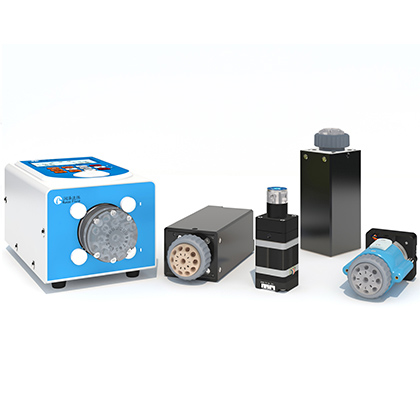
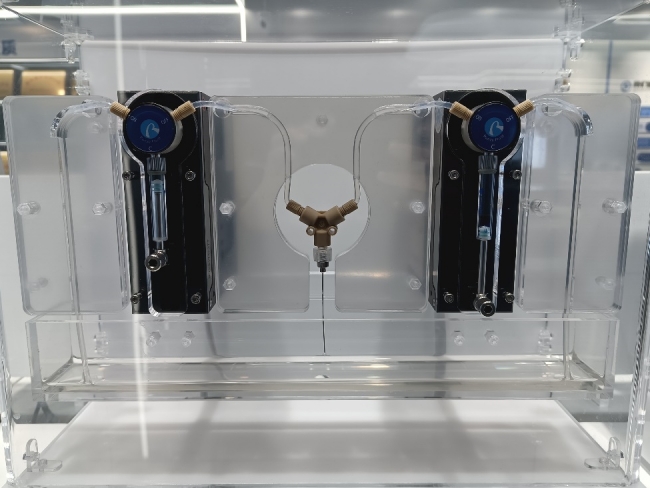
Dual syringe pump continuous flow is used when one syringe pump cannot maintain uninterrupted outlet delivery because it must periodically refill. In the source guide, the application need is continuous filling or long-term reaction dosing. The tested solution uses two SY-01B syringe pumps in parallel so that one pump dispenses while the other refills and prepares for the next dispense cycle.
The documented system uses TTL input and output signals on the DB15 interface of two SY-01B syringe pumps. The pumps are cross-connected so each unit can trigger the other after a configured action. The test medium was pure water, the power supply was DC24V, communication was RS485, and the syringe volume was 500 uL borosilicate glass.
A dual syringe pump continuous flow system alternates two pumps. While pump #1 dispenses, pump #2 refills and switches its valve to the outlet. Before pump #1 finishes, it triggers pump #2 to start dispensing. Pump #1 then refills and waits for the next trigger. This reduces the outlet interruption caused by a single pump refill-dispense cycle.
In the documented SY-01B test, pump #1 TTL input pin 7 connects to pump #2 TTL output pin 13, pump #1 TTL output pin 13 connects to pump #2 TTL input pin 7, and both grounds connect through pin 10. The lab test achieved continuous, stable, uninterrupted output at the common outlet under the documented water-test conditions.
Item | Documented value |
Pump model | Two SY-01B syringe pumps |
Test medium | Pure water |
Ambient condition | 20 +/- 2 C, 45-75% RH |
Power supply | DC24V |
Communication | RS485 |
Syringe volume | 500 uL borosilicate glass |
Outlet tubing | FEP tubing, 1.6 x 3.2 mm |
Outlet merge | Y-shaped three-way connector and Luer needle |
A syringe pump has a finite syringe volume. During dispensing, liquid leaves the syringe. When the syringe reaches the end of its dispense stroke, the pump must aspirate again before output can continue. That refill step creates an interruption in single-pump systems.
The dual-pump method solves the timing problem. The active pump supplies the outlet while the standby pump refills. The critical engineering task is timing: the standby pump must begin delivery before the active pump fully stops.
The source guide documents TTL cross-triggering through the DB15 interface. Pump #1 input pin 7 connects to pump #2 output pin 13. Pump #1 output pin 13 connects to pump #2 input pin 7. Pump #1 ground pin 10 connects to pump #2 ground pin 10.
The working sequence is: pump #1 dispenses, pump #2 fills; pump #2 switches to the outlet and waits; pump #1 approaches the end of stroke and triggers pump #2; pump #1 finishes, refills, switches to outlet, and waits for pump #2 to trigger it.
Item | Single syringe pump | Dual SY-01B system |
Output during refill | Interrupted | Reduced interruption through alternating pumps |
Hardware | One pump | Two pumps, TTL wiring, merged outlet |
Control | Simpler | Requires trigger logic and command setup |
Suitable use | Batch dispense | Continuous filling or long-term dosing |
Optimization | Flow and volume | Trigger point, refill speed, valve timing |
The source guide recommends re-optimizing the trigger point, remaining volume, and refill speed when viscosity, tubing length, or back pressure changes. It does not provide pulsation value, flow accuracy, trigger delay, or TTL electrical limits. Data not available in source documents.
What is dual syringe pump continuous flow?
It is an alternating method where one syringe pump dispenses while the second pump refills and prepares to dispense.
Which pump was tested?
The documented test used two SY-01B syringe pumps.
What communication method was used?
The documented communication method was RS485.
Which TTL pins were used?
Pin 7 was TTL input, pin 13 was TTL output, and pin 10 was ground.
What liquid was tested?
Pure water was used in the documented test.
Does the source provide pulsation data?
No. Data not available in source documents.
Dual syringe pump continuous flow is a practical way to reduce interruption in syringe-pump liquid delivery. The documented SY-01B test uses TTL cross-triggering, RS485 communication, a 500 uL syringe, FEP tubing, and a Y-shaped outlet connector. For real applications, engineers should validate trigger timing, refill speed, valve switching, viscosity, tubing resistance, and back pressure.


 English
 日本語
日本語 한국어
한국어 français
 Deutsch
 Español
 italiano
 русский
 português
 Türkçe
 Nederland