
86-025-5119 7362

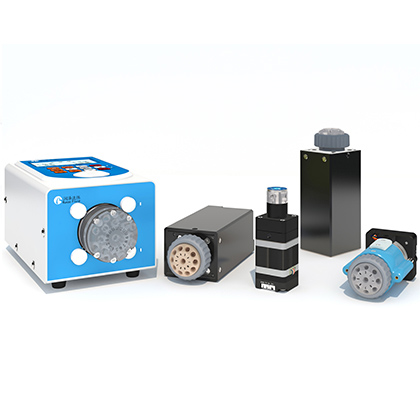
An RZ01B peristaltic pump can be configured around a stepper motor, a brushless DC motor, or a brushed DC motor, and the correct choice depends on how the OEM machine will control and verify fluid delivery. The platform keeps the fluid inside the pump tube and uses a compact RZ01B pump head, but the motor changes the available control interface, operating speed, electrical requirements, and validation plan. Engineers should therefore select the drive architecture before finalizing tubing, connectors, mounting, and control electronics.
The RUNZE catalog separates the platform into the BJ-RZ01B stepper model and the ZL WS or YS RZ01B direct-current models. The sales-experience record describes the same choice in practical terms: use a stepper configuration when the machine needs commanded motion and a driver-based interface, use brushless DC when a fixed high-speed motor with external control inputs fits the design, and use brushed DC when a simple polarity-controlled motor is acceptable. These distinctions guide selection; they do not replace application testing with the actual liquid and tube.
Choose the BJ-RZ01B stepper version when the controller must command motion through pulse and direction signals and the application needs an adjustable speed range up to the catalog limit of 400 rpm. Choose the 24 V brushless DC version when the system can use a nominal 420 rpm motor and benefits from dedicated PWM, emergency-stop, and direction wiring. Choose the 24 V brushed DC version when the design can accept polarity reversal for direction and does not require the brushless control leads. The catalog lists maximum reference flow values of 152 mL/min for BJ-RZ01B, 140 mL/min for the brushless ZL WS configuration, and 145 mL/min for the brushed ZL YS configuration under stated water-test conditions. Treat these values as references and validate the selected tube, liquid, back pressure, duty cycle, and control method in the final machine.
The RZ01B pump head uses a PPS housing and POM rollers. The catalog describes four rollers with moderate pulsation, a transparent PC cover for viewing operation, a rotation-locking structure, and a pump head designed for cleaning without hidden corners. Both the catalog and sales record position the platform for OEM integration. The fluid contacts the tube rather than the pump body, so fluid compatibility is primarily a tube-selection and connector-selection question.
The common pump-head platform does not make the three drive choices interchangeable. The BJ-RZ01B uses a 42-size stepper motor and is available without a driver or with a driver. The direct-current catalog page lists separate brushless and brushed 24 V variants. Each has different wiring and control behavior, so an OEM should not choose a motor only from the maximum reference flow.
Configuration | Catalog control basis | Published operating data | Best fit for evaluation |
BJ-RZ01B stepper | Four motor leads; optional pulse and direction driver | Up to 400 rpm; 152 mL/min maximum reference flow | Machines that need commanded speed and indexed motion |
ZL WS RZ01B brushless DC | 24 V motor with PWM, emergency stop, and direction leads | 420 rpm plus or minus 10 percent; 140 mL/min maximum reference flow | Systems using an external DC control interface at nominal high speed |
ZL YS RZ01B brushed DC | 24 V motor; direction changes by reversing polarity | 420 rpm plus or minus 10 percent; 145 mL/min maximum reference flow | Simple drive circuits where polarity control is acceptable |
The reference flow values above were measured with stated tubing and water under catalog conditions. They are not guaranteed delivery rates for every liquid, tube lot, pressure, or service life. The catalog does not publish one accuracy specification that applies equally to all three motor options. Data not available in source documents.
The BJ-RZ01B is the clearest starting point when the host controller must set motion through a driver rather than simply power a fixed-speed motor. The motor interface identifies A plus, A minus, B plus, and B minus leads. The driven version exposes pulse, direction, and enable terminals, and the catalog illustrates common-anode and differential connection arrangements. This gives the machine designer a defined motion-command interface, but the controller, pulse frequency, acceleration profile, and calibration method remain part of the OEM design.
The catalog lists a speed range no higher than 400 rpm, a step angle of 1.8 degrees, 2.4 V phase voltage, 2 A rated current, 9.6 W maximum output power, and an operating environment of minus 10 to plus 50 degrees C for the imported 42-size stepper motor. Those are motor and product data, not a completed dosing-performance specification. If the application requires a target volume per cycle, establish a calibration curve with the actual tube and fluid after the pump is installed in its final mechanical orientation.
The brushless ZL WS RZ01B is a 24 V direct-current option with a catalog speed of 420 rpm plus or minus 10 percent. The motor data list 0.6 A at no load, 2.3 A at rated load, 9.5 kgf.cm torque, clockwise or counterclockwise operation, and an operating temperature of 0 to 40 degrees C. The wiring guidance identifies separate leads for PWM, emergency stop, direction, motor positive, and motor negative.
This interface is useful when the OEM controller already provides a compatible DC motor control signal and does not need a stepper driver. The dedicated control leads are also more explicit than reversing supply polarity. However, the source documents do not publish PWM frequency limits, duty-cycle-to-speed linearity, closed-loop speed accuracy, or a universal service-life value for this motor. Data not available in source documents. Confirm those items before committing the production electronics.
The brushed ZL YS RZ01B uses a 24 V direct-current motor with two power terminals. The catalog says the direction changes when the supply polarity is reversed. It lists 0.8 A at no load, 3.0 A at rated load, 420 rpm plus or minus 10 percent, 9 kgf.cm torque, and an operating temperature of 0 to 40 degrees C. This makes the electrical concept simple, but the machine still needs correctly rated switching and protection components.
A brushed motor can fit cost-sensitive or uncomplicated continuous-transfer equipment when the duty cycle and maintenance plan are acceptable. The sales record describes it as the more economical option, but neither source provides a price difference, brush replacement interval, electrical-noise limit, or comparative lifetime against the brushless version. Data not available in source documents. Do not convert a qualitative cost statement into a procurement saving without a current quotation and life test.
Motor selection controls how the rollers move, while the tube determines the wetted material and strongly affects delivered flow. The BJ-RZ01B catalog table provides water-test reference flows at 400 rpm for four 1.6 mm wall tubes: 15 mL/min for 0.8 by 1.6 mm, 48 mL/min for 1.6 by 1.6 mm, 94 mL/min for 2.4 by 1.6 mm, and 152 mL/min for 3.2 by 1.6 mm, where the first value is tube ID and the second is wall thickness. The catalog labels these as reference data.
The direct-current catalog page publishes separate maximum reference flows for its tested configurations rather than a full comparative tube table in the extracted source. An OEM should therefore avoid applying the BJ-RZ01B flow table directly to a DC model. Select the tube by chemical compatibility, dimensions, expected pressure, temperature, and service conditions, then measure flow on the chosen motor configuration. If the application cannot tolerate pulsation or tube wear drift, define an external calibration or verification method at system level.
1. Define the fluid task. Record the liquid, required flow range, duty cycle, allowed pulsation, back pressure, temperature, and cleaning method.
2. Choose the control architecture. Decide whether the host will send step and direction pulses, a PWM and direction interface, or switched DC polarity.
3. Check electrical capacity. Use the catalog current, voltage, and temperature data to size the driver, power supply, switching components, and protection margin.
4. Select the tube and connection method. Confirm tube material, ID, wall thickness, external connections, and chemical compatibility with the actual fluid.
5. Verify mechanical integration. Check the product drawing, mounting holes, tube-change access, cover clearance, and cable routing in the equipment enclosure.
6. Build a calibration matrix. Measure flow at the intended settings with the production tube and liquid, then repeat after representative operating time.
7. Test abnormal conditions. Include blocked outlet, empty inlet, power interruption, emergency stop where applicable, and controller restart behavior within the machine risk assessment.
8. Freeze the production configuration. Record the exact pump code, tube code, driver, firmware parameters, wiring diagram, and acceptance method.
· Required flow accuracy and repeatability at the actual dispensing volume
· Flow variation as the tube ages or after cleaning and sterilization
· Maximum allowable back pressure for the selected tube and connection set
· Noise and vibration limits inside the finished instrument
· Motor life at the specified load and duty cycle
· PWM frequency and speed-control transfer function for the brushless motor
· Acceptable acceleration and deceleration settings for the stepper system
· Chemical compatibility of every wetted tube and fitting
The source documents do not provide universal limits for these items. Data not available in source documents. They should appear in the OEM validation plan rather than being inferred from a maximum reference flow.
The BJ-RZ01B stepper catalog lists a speed range up to 400 rpm and supports a driver-based pulse and direction interface. The DC versions are listed at 420 rpm plus or minus 10 percent. The source does not provide a complete low-speed comparison among all versions.
The catalog lists 152 mL/min with the stated 3.2 by 1.6 mm tube at 400 rpm in a room-temperature, atmospheric-pressure water test. It is a reference value and must be verified in the actual system.
The catalog identifies leads for PWM, emergency stop, direction, motor positive, and motor negative. Confirm the electrical levels and detailed control requirements with the applicable product documentation before designing the production interface.
The catalog says direction is reversed by swapping the supply polarity at the two motor terminals. The OEM circuit should include correctly rated switching and protection components.
No common calibration curve is published. Motor type, speed, tube dimensions, tube condition, liquid, and back pressure can change delivery. Calibrate the exact production configuration.
The sales record states that fluid remains inside the pump tube and does not contact the pump body. Compatibility still needs to be confirmed for the tube and all external wetted connectors.
The sources describe brushless operation as stable but do not publish a comparative lifetime for the stepper, brushless, and brushed versions. Data not available in source documents.
RZ01B peristaltic pump selection should begin with the machine control architecture, then move to tubing and application validation. The BJ-RZ01B stepper version suits pulse-and-direction motion control and an adjustable range up to 400 rpm. The brushless DC version adds dedicated PWM, emergency-stop, and direction leads around a nominal 420 rpm motor, while the brushed DC version uses a simpler polarity-reversal interface. Catalog flow values help size an initial prototype, but they are water-test references. The final choice should be qualified with the production tube, liquid, pressure, duty cycle, wiring, and acceptance method.



 English
 日本語
 한국어
 français
 Deutsch
 Español
 italiano
 русский
 português
 Türkçe
 Nederland