
86-025-5119 7362

A reliable fluid connection starts with a matched thread, sealing seat, and tubing outside diameter. When an analytical instrument combines a pump, valve, and detector from different suppliers, a connector that appears to fit can still have the wrong sealing geometry. This guide explains how to distinguish two RUNZE fitting families and document the connection before ordering.
PEEK fitting compatibility is the match between the receiving port, connector thread, sealing geometry, and tubing outside diameter under the intended operating conditions. A material name alone cannot establish that match. Start with the port drawing and then select the connector and tube as a complete assembly.
The RUNZE peek fittings range includes several connection designs. Treat the category as a starting point for identifying a suitable family. Confirm the exact part number, mating port, and tube dimensions before adding a connection to the bill of materials.
The table below summarizes dimensions and structures published on the corresponding RUNZE product pages. It compares interface compatibility only; it does not establish a common pressure rating for the two families.
Check | PEEK one-piece family | PEEK flangeless family |
Published interface | 10-32 UNF coned port | 1/4-28 flat-bottom port |
Published tubing OD | 1.6 mm | 1.6, 2.0, 2.5, 3.0, or 3.175 mm |
Construction | One-piece PEEK fitting | PEEK nut with ETFE ferrule |
Example identification | WK11A-10-32-K and other listed WK11 variants | Select the nut and ferrule for the exact tube OD |
Essential drawing check | Coned receiving seat and seating depth | Flat-bottom receiving seat and ferrule arrangement |
Source: RUNZE PEEK One-Piece Fittings and PEEK Flangeless Fittings product specifications, checked 17 November 2026. Confirm the ordered configuration with RUNZE.
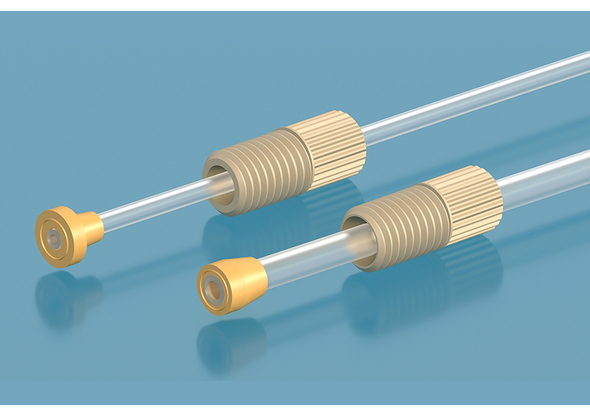
The thread moves the connector into the port; the sealing surfaces establish the fluid boundary. Identifying a thread without checking the seat leaves a critical part of the connection undefined. The same tubing OD can be used with different connector systems, so tube size cannot identify the port by itself.
For a drawing-based reference, the Biotech Fluidics threaded adapter guide distinguishes coned 10-32 interfaces from flat-bottom 1/4-28 interfaces. This supports checking both thread and seat when crossing between components.
Suppose a valve drawing specifies 1/4-28 flat-bottom while a downstream component specifies 10-32 coned. Prepare separate connection entries for the two ends. If an adapter is needed, specify both adapter interfaces and its flow bore. Do not describe the assembly simply as a 1.6 mm tubing connection.
A two-piece connection needs the correct nut and ferrule combination. The flangeless nut is one component of that assembly. Confirm ferrule orientation and tube size using the selected product instructions, especially when several similar-looking ferrules are stored together.
Outside diameter controls mechanical fit, while inside diameter affects fluid volume and resistance. RUNZE lists peek capillary tubing separately from its connectors. Record both ID and OD in purchasing documents so a replacement tube retains the intended fluid path as well as the correct mechanical connection.
For example, two tubes can share a 1.6 mm OD but have different internal bores. Replacing one with the other can preserve the external connection while changing the volume between the valve and detector. An interface checklist should therefore include dimensions on both sides of the tube wall.
Give every joint a connection ID on the fluid schematic. Record the component port reference, thread, seat type, tubing material, ID, OD, connector part number, ferrule specification, and drawing revision. Add the working liquid, temperature, and pressure so the supplier can assess the complete assembly.
For the RUNZE 10-32 coned family, the one piece connectors page provides model identification and the published 1.6 mm tubing OD. Keep that identification attached to the connection record instead of relying on an operator's visual recognition of a knurled fitting.
Include maintenance access in the review. Check whether a technician can hold the tube in position and reach the connector after installation. A compatible joint that cannot be assembled consistently inside the instrument still needs a layout change.
Use a clean, square tube end and follow the exact fitting instructions. Verify that the tubing reaches its intended seat before tightening. Stop and inspect a joint that binds unexpectedly; additional force cannot correct a mismatched thread or sealing surface.
The Merck HPLC troubleshooting guide notes that incompatible fittings may initially appear to fit and later leak. When replacing components, compare the new joint with the original drawing and repeat the relevant leak and functional checks.
For a RUNZE quotation, submit the connection list and port drawings with the proposed peek tube fittings. Ask for confirmation of the matched parts and application limits. This gives purchasing a defined assembly to order and gives engineering a traceable basis for future substitutions.
Keep the original dimension notation from each drawing. If a tube or fitting is described in inches, retain that value alongside any metric conversion. A rounded conversion is useful for reading but does not define the permitted dimensional tolerance or authorize substitution between nominal tube sizes.
Specify PEEK connections through thread, sealing seat, and tubing dimensions. A clear interface record reduces ambiguity when selecting peek connectors, changing suppliers, or servicing an analytical instrument. The useful purchasing output is a matched connection with a confirmed part number and operating conditions.
No. The two RUNZE families described here use different threads and sealing geometries.
No. Tubing OD identifies a mechanical tube dimension, while the port still needs its own thread and seat specification.
No. The RUNZE flangeless family described here combines a PEEK nut with an ETFE ferrule.
Yes. Thread engagement alone does not verify the sealing seat or correct tubing position.
Send port drawings, tubing ID and OD, fluid details, and operating conditions with the proposed connection list.



 English
 日本語
 한국어
 français
 Deutsch
 Español
 italiano
 русский
 português
 Türkçe
 Nederland