
86-025-5119 7362

Microfluidic systems are defined by their precision—handling minute fluid volumes with high sensitivity. In such systems, a small, often overlooked component like a fluidic check valve plays a monumental role. If the valve's cracking pressure is too high, pumps stall, halting flow. If it’s too low, you risk compromising your system with backflow contamination.
The demands on engineers have never been higher, as the rising trend toward smaller, modular medical devices and lab-on-a-chip setups requires the utmost precision in barbed check valves. This guide will help you master the most critical balance in fluidics: sizing a barbed check valve by balancing cracking pressure and flow rate.
Cracking pressure is the minimum upstream pressure required to open a check valve and allow the fluid to flow. It can vary by design but serves as a key determinant of how fluid flows through microfluidic systems.
Technical Breakdown:
At its core, cracking pressure is influenced by elements like surface tension and the mechanical properties of the internal valve diaphragm (commonly crafted from materials like silicone or Viton). It ensures the valve remains shut under low pressure, effectively blocking backflow, until the system builds sufficient pressure to push through.
Expert Tip: Cracking pressure acts more like a "gradient" than a strict barrier. The pressure required to maintain flow is often lower than the cracking pressure itself, especially for fluids with lower viscosities.
In precision environments like medical or chemical applications, the smallest discrepancies can cause cascading issues. The wrong cracking pressure could lead to:
System failures: Pumps stalling or cavitating due to an excessively high resistance.
Contamination: Backflows introduce contaminants or impurities into sterilized environments.
Understanding how cracking pressure meets flow rate requirements ensures smooth operation over a wide range of demanding scenarios.
A fundamental relationship in fluidics is the trade-off between cracking pressure and flow rate: As cracking pressure increases, the flow through the valve typically decreases—and vice versa.
High-performance fluidic check valves must minimize pressure drop once they’re fully opened, while also sealing tightly when closed. However, this balance is not always easy to achieve. Engineers need to understand the dynamics of flow curves created by different crankshaft spring tension and diaphragm materials.
A simple table or graph can clarify performance:
| Cracking Pressure | Flow Rate (mL/min) | Pressure Drop (PSI) |
| 0.5 PSI | 500 | 0.1 |
| 2.0 PSI | 300 | 0.4 |
| 5.0 PSI | 100 | 0.9 |
Insight: Choosing a higher cracking pressure can stabilize backflow prevention, but may cause pulse dampening in low-flow syringe pump applications—disrupting an even stream.
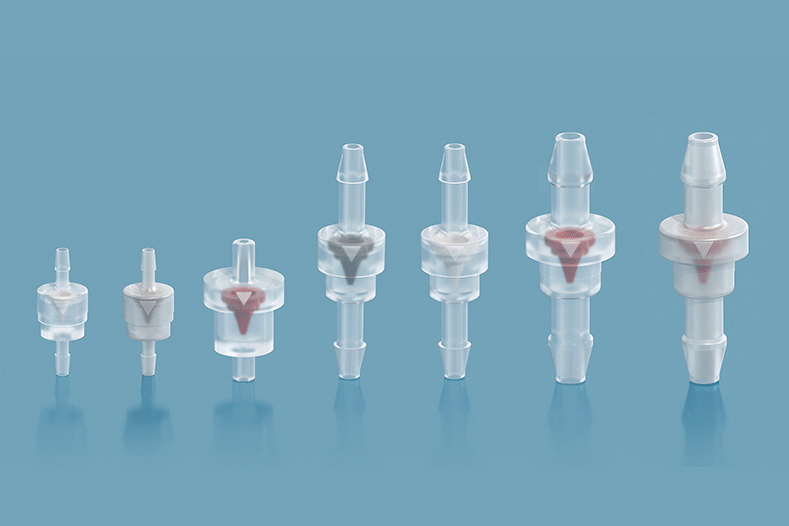
Barbed check valves are the gold standard for microfluidic systems, especially lab-on-a-chip setups or modular devices. But why are they the preferred choice?
Ease of Integration: Barbed fittings slide directly into standardized laboratory tubing, including materials like PTFE, silicone, or Tygon.
Leak Prevention: The barb profile creates a strong seal by pressing tightly against the inside diameter of the tubing (ID). External clamps become unnecessary even in higher-pressure applications.
Versatility: Available in a variety of sizes, barbed check valves can be quickly adapted to suit systems ranging in fluid flow type, pressure, and material compatibility.
The material composition of a barbed check valve is as important as its design when dealing with critical applications like diagnostics or chemical analysis.
Whether working with harsh chemicals or sensitive biological samples, always consider the material of your valve's wetted parts. Here are the most common choices:
Polypropylene (PP): Ideal for general use and non-aggressive compounds.
PVDF: Offers superior resistance to acids and aggressive cleaning solvents.
PEEK (Polyetheretherketone): Best for extreme chemical resistance, commonly used in medical-grade settings.
EPDM (Ethylene Propylene): Resistant to many polar solvents but limited for use in oil-based systems.
FKM/Viton: Preferred for applications demanding long shelf life, chemical durability, and high temperatures.
Even experienced engineers fall victim to common mistakes that compromise their systems’ efficiency. Avoid these pitfalls:
Ignoring Internal Volume: A valve with high dead volume creates air bubbles and introduces sample distortion, particularly in small-scale diagnostics.
Overestimating Re-Seal Pressure: A "snap shut" mechanism that closes too slowly (e.g., at 0.5 PSI when 1 PSI opening pressure is required) can cause backflow issues in vertical systems.
Overlooking Fluid Viscosity: High-viscosity fluids require higher cracking pressures to overcome internal resistance, potentially throwing off performance metrics.
Sizing your barbed check valve doesn’t have to be guesswork. Follow these steps to ensure you’re getting the perfect fit:
Define Maximum Allowable Back-Pressure: Understand your system’s tolerance for reverse flow.
Determine Target Flow Rate: Define operational flow in μL/min or mL/min to ensure smooth delivery.
Check Tubing ID: Match your valve barb with the compatible tubing ID for a leak-free connection.
Consult Product Specifications: Many manufacturers, such as Runze Fluid, provide performance curves tailored to your system's needs.
When it comes to microfluidics, every detail matters. An incorrectly sized barbed check valve can create inefficiencies, while the right one ensures optimal performance and safety for your system.
At Runze Fluid, we specialize in designing and delivering high-precision barbed check valves that meet challenging demands in medical devices, lab-on-a-chip setups, and chemical analyzers.


 English
 日本語
日本語 한국어
한국어 français
 Deutsch
 Español
 italiano
 русский
 português
 Türkçe
 Nederland